This post is also available in:
 עברית (Hebrew)
Ground robots often struggle with one recurring problem: every terrain demands a different movement strategy. Smooth surfaces favor wheels, rubble demands crawling, and narrow gaps require extreme flexibility. Most robots can master one or two of these challenges—but rarely all of them. A new Israeli research project attempts to bridge that gap with a platform designed to reconfigure itself on the move.
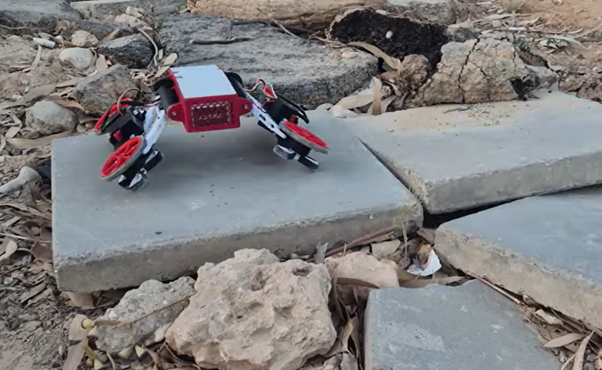
Developed at Ben-Gurion University’s Zarrouk Lab, the DSTAR robot is built around the idea that shape adaptation can dramatically expand ground mobility. Instead of relying on a fixed chassis, the robot combines two mechanisms that allow it to widen, narrow, lift, or lower different parts of its body. This lets it choose the right gait—rolling, crawling, or climbing—based on what lies ahead.
According to Interesting Engineering, the key problem the robot addresses is traversing real-world obstacles without getting stuck. In testing, the robot maneuvered through a 10 cm-wide gap, climbed a 20 cm plank, stepped up onto a 15 cm curb, crossed a horizontal gap, and negotiated uneven steps and sloped surfaces. Many of these tasks required the robot to reposition its wheel arms to gain traction or shift its center of mass to stay balanced, which are abilities that conventional wheeled robots lack.
The robot’s movement comes from a combination of:
- Sprawling mechanism, which spreads or contracts its wheel arms to change stance width.
- Four-bar extension mechanisms (FBEM), two adjustable linkages that lift or lower specific sides of the robot.
With these tools, DSTAR can adjust its posture as an animal would—adopting a turtle-like gait in tall grass, widening its stance on loose soil, or raising one side to clear a narrow space. According to the research team, this hybrid approach improves climbing performance by 66% compared to earlier symmetric FBEM designs.
For defense, homeland security, and emergency response organizations, such adaptive mobility is valuable. Robots capable of navigating collapsed buildings, obstructed pathways, or debris-filled areas can support reconnaissance, victim search, and hazardous-environment assessments without putting personnel at risk. Their ability to move through confined or unstable terrain also makes them useful for tunnel inspection, border surveillance, and CBRN incident response.
The project demonstrates how combining mechanical reconfiguration with smart gait selection can produce a robot capable of handling terrain that defeats most conventional ground platforms. As research continues, shape-shifting ground robots may become essential tools in both rescue operations and security missions where adaptability matters as much as durability.
The research was published here.