

This post is also available in:
 עברית (Hebrew)
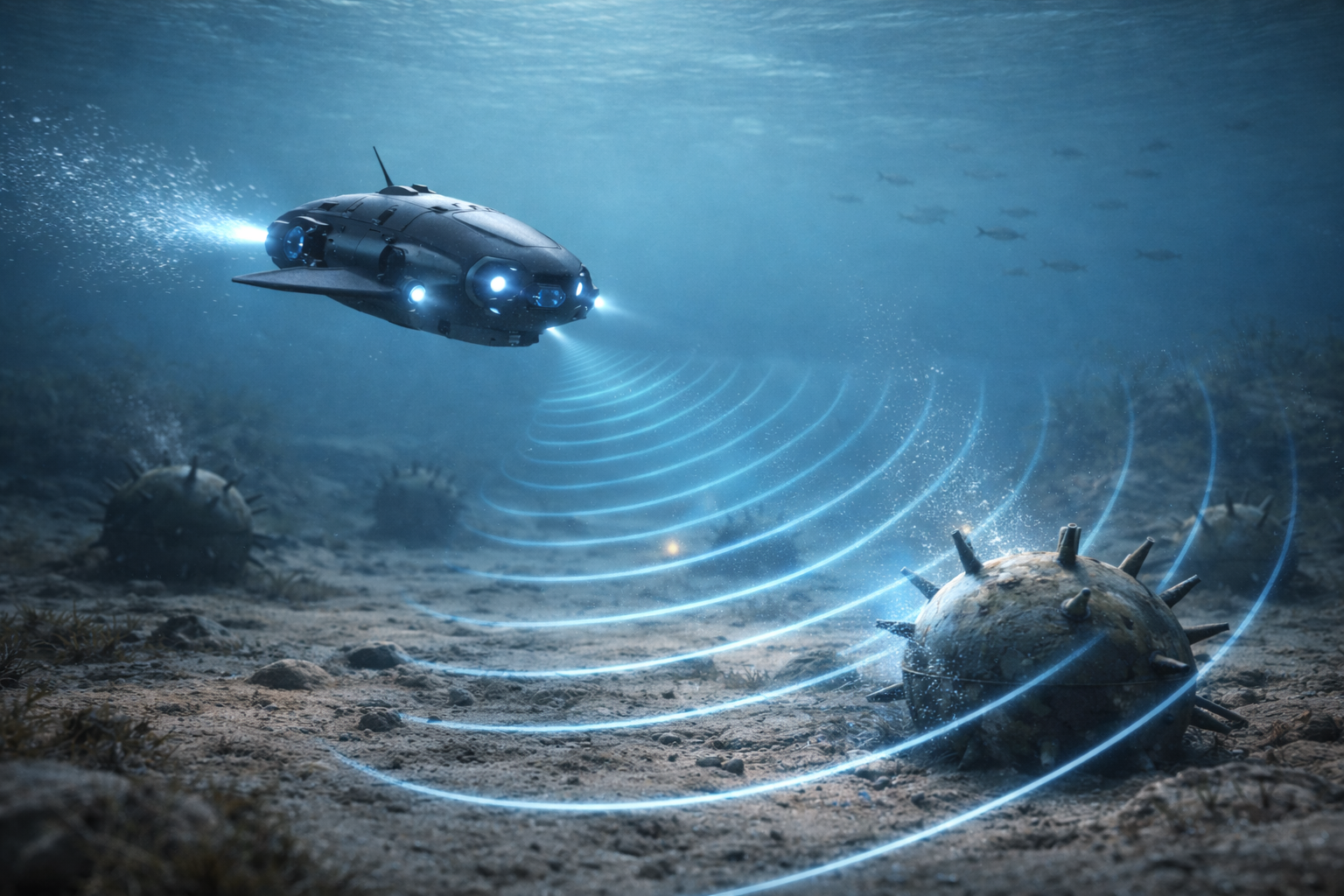
Naval mines remain a quiet but persistent danger. Cheap to deploy and difficult to detect, they can block ports, restrict maneuver, and threaten both military and commercial shipping. Clearing them has traditionally required slow, methodical operations carried out by crewed ships or helicopters flying low over contested waters—an approach that exposes personnel to significant risk and limits how quickly large areas can be made safe.
A recent US Navy demonstration suggests a different path. During open-water trials off Panama City, Florida, an unmanned surface vessel successfully towed the AN/AQS-24 minehunting system, a sonar suite originally designed for helicopter-based operations. The test confirmed that a capability long associated with airborne mine countermeasures can be transferred to an uncrewed maritime platform without sacrificing performance.
The system is built for speed and coverage. Unlike slower, traditional minehunting sonars, it can operate at speeds of up to 33 kmph while scanning large swaths of the seabed. Using high-resolution side-scan sonar, the system detects and localizes both bottom and moored mines, while advanced onboard processing helps distinguish real threats from debris or natural features. This allows operators to survey wide areas quickly rather than inching forward at low speed.
According to Interesting Engineering, to improve identification, the system pairs sonar with a laser line scanner. Once a potential mine is detected acoustically, the laser provides optical imagery to confirm its shape and characteristics. Running both sensors at the same time helps reduce blind spots caused by water conditions or seabed clutter and lowers the risk of false alarms. Features such as target box cueing further focus operator attention on areas that warrant closer inspection.
From a defense standpoint, the shift to uncrewed minehunting is significant; naval mines are widely regarded as one of the most cost-effective tools for denying access to critical waterways, especially near chokepoints and hostile coastlines. By moving detection tasks onto unmanned surface vessels, navies can reduce exposure of sailors and aircrews while maintaining the tempo needed to reopen sea lanes.
The demonstration also highlighted how mature systems can gain new relevance when paired with autonomous platforms. The system has logged thousands of operational tow hours from helicopters over decades of service. Adapting it for uncrewed surface use builds on that experience while fitting into a broader push toward distributed, lower-risk mine countermeasures.
As maritime environments become more contested, combining proven sensors with unmanned platforms may prove essential to keeping fleets—and shipping routes—moving safely.























