





INNOFENSE Is Looking for the Next Generation of Dual-Use Startups
iHLS and the Ministry of Defense invite you to join the seventh cycle of INNOFENSE and receive a remarkable opportunity to showcase your technology...
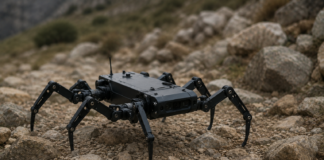
AI Gives This Six-Legged Robot an Insect-Inspired Way to Walk
Legged robots can cross terrain that stops wheeled machines, but coordinating several legs over unpredictable ground is difficult. Many robots rely on predefined gaits,...

This Tiny Robot Can Keep Jumping as Long as the Light...
Small robots designed to cross rough terrain face a basic mechanical challenge: jumping usually requires a mechanism to store energy, release it and then...

A New Trailer Can Charge Drones, Power Sensors and Haul Cargo
Supplying electricity on the modern battlefield is becoming almost as important as delivering fuel or ammunition. Military units now rely on drones, electronic warfare...

INNOFENSE Call for Startups – Dual-Use Technologies
Following the immense success of the previous cycles and their integration into the defense sector, iHLS and the Ministry of Defense invite you to...

Scientists Found a Way to Send Data Through Distorted Light
Free-space laser communications promise fiber-like data rates without requiring a physical cable, making them attractive for satellites, remote locations and other environments where laying...

Not Just What You Say, but How You Say It: Timlul’s...
Timlul is a graduate of the INNOFENSE Innovation Center operated by iHLS in collaboration with IMoD. This unique acceleration program removes entrance barriers to the technological...

China and Iran Have a New Surveillance Assistant: AI
Modern surveillance operations can require substantial technical resources. Investigators may need to identify people across social networks, connect information scattered between accounts and build...

AI Leaders Want to Slow the Race Before Safety Falls Further...
Artificial intelligence systems are becoming more capable of acting independently, using external tools and interacting with real-world digital infrastructure. That progress is creating a...

This Cyber Test Creates Thousands of Malware Variants to Challenge Defenses
Cybersecurity tools are typically tested against known malicious files and behaviors, but real attackers rarely leave their code unchanged. Malware can be rewritten or...

Cyborg Cockroaches Are Getting Smarter at Navigating Difficult Terrain
Small robots could be valuable for exploring collapsed buildings, damaged infrastructure and other spaces that are too confined or dangerous for people. But building...

This New Acoustic Chip Could Solve One of 6G’s Biggest Problems
As wireless networks become faster and more demanding, the tiny radio-frequency chips inside smartphones and communication systems are approaching their physical limits. Acoustic wave...

Disconnected by Design: Agentic AI Platform InteliATE Built for Simple &...
InteliATE is a graduate of the INNOFENSE Innovation Center operated by iHLS in collaboration with IMoD. This unique acceleration program removes entrance barriers to the technological...

This Cold-Proof Material Could Give Wearable Sensors a Winter Upgrade
Wearable sensors need to remain soft and conductive as the body moves, but cold weather presents a basic materials problem. Many flexible sensors use...

AI Is Changing the Rules of Cyber Warfare
Artificial intelligence is rapidly changing the pace of cybersecurity. Tasks that once required teams of skilled attackers working for days or weeks can now...

When GPS Goes Dark, Hypersonic Weapons Could Navigate by the Stars
Hypersonic vehicles create an unusually difficult navigation problem. Traveling at several times the speed of sound leaves little room for positioning errors, while satellite...

A New Underwater Robot Is Built to Hunt for Threats on...
Inspecting the underside of a ship is a difficult but important security task. Hulls can conceal structural damage, foreign objects or potentially dangerous devices...

This Skin-Cell-Sized Sensor Could One Day Help Detect Submarines
Detecting extremely weak magnetic fields is useful in everything from medical imaging to industrial monitoring, but sensitivity comes with a fundamental problem: noise. As...

A Tiny Levitating Gyroscope Could Make GPS-Free Navigation More Accurate
Modern navigation depends heavily on satellite signals, but GPS is not always available. Signals cannot reliably penetrate underground or deep underwater and can also...

The Biggest Thing Holding Back Next-Gen Radar? Heat
Gallium nitride has become an important material for high-performance radar, communications and electronic warfare systems because it can handle far more radio-frequency power than...

This Security Tool Looks Inside AI to Catch Agents Going Rogue
As organizations begin deploying teams of AI agents to handle complex tasks, cybersecurity is becoming a growing concern. In these multi-agent systems, several large...

This Tiny Cyber Probe Can Tell When a Device Has Been...
Protecting critical systems becomes especially difficult once an attacker gets inside the device itself. Conventional cybersecurity tools can monitor network traffic, identify known vulnerabilities...
Latest

INNOFENSE Launches New Call for Breakthrough Dual-Use Technologies
Following the achievements of previous cycles, iHLS and the Ministry of Defense are opening applications for the seventh cycle of INNOFENSE. The program offers...