

Self-Charging Humanoids Step in for Border Duty
Border checkpoints are under increasing pressure to manage rising traveller volumes, evolving security demands, and labor-intensive inspection routines. Many of these sites operate around...

A New Kind of Stealth: Using Radar Energy Instead of Batteries
Modern military and civilian systems face a growing power and connectivity problem. Sensors, communications, and autonomous platforms all demand more energy, yet batteries add...

Is It Possible To Control A Swarm of 200 Drones Single-Handedly?...
The effective coordination of numerous unmanned aerial vehicles presents a significant logistical and operational challenge. Traditional models, where a single operator controls one or...

Snap, Scan, Know: AI Identifies Military Gear in Seconds
Identifying military equipment quickly and accurately remains a challenge, particularly in fast-moving operational or training environments. Analysts and personnel often rely on manual comparison,...

A Smarter EW Platform Can Detect Threats Without Broadcasting Signals
Modern battlefields are saturated with electronic activity. Drones, radars, radios, data links, and command networks continuously emit signals that can reveal the location and...
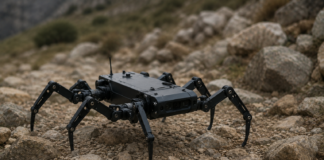
AI Gives This Six-Legged Robot an Insect-Inspired Way to Walk
Legged robots can cross terrain that stops wheeled machines, but coordinating several legs over unpredictable ground is difficult. Many robots rely on predefined gaits,...

Meet Unique Emergency Drone for Arctic Conditions
Commercial shipping, tourism and cruise ship traffic to the Norwegian northern archipelago of Svalbard and the surrounding marine areas have all grown dramatically in...

Social Media Analytics for Emergency Response
Medical emergencies for fans during sports events can quickly turn into life-or-death situations. Purdue University researchers have developed a technology to help police monitor...

Call for Technologies: Defense Industry Seeks AI Solutions
iHLS, in collaboration with a large defense industry is looking for companies with proven capabilities in several areas to participate in a demonstration of...

New SIGINT Prototype Aims to Keep Units Connected When Signals Disappear
Modern military operations depend on uninterrupted communication and rapid data sharing, yet many battlefields are anything but cooperative. Urban density, electronic warfare, and natural...

A New Kind of Drone Built for Waterborne Activities
Filming on water has long posed a challenge for aerial cameras. Conventional drones struggle with spray, wind, and the simple problem of takeoff and...
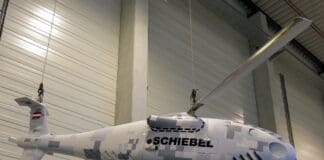
The Airborne Interceptor Built for Persistent Threats
Countering long-range attack drones has become a persistent challenge for air defense planners. Low-cost, long-endurance UAVs can loiter for hours and strike far from...

A Battlefield Chatbot That Answers in Real Time
Modern military operations generate vast amounts of data, but turning that information into actionable insight at the right moment remains a challenge. Lessons learned...

This Radar Can Spot and Update Threats Every Second
Modern air-defense systems face an increasingly difficult task. Drones, cruise missiles, helicopters, rockets, and high-speed aircraft can all appear simultaneously, often operating at different...

Apply Now! Your Chance to Win Exclusive Security and HLS Startup...
iHLS is delighted to host for the first time the prestigious Startup Competition for innovative technologies in the security, defense and homeland security fields,...

Smart, Stealthy, and Squishy: An Underwater Jellyfish Robot
Chinese researchers have unveiled a new biomimetic underwater robot designed to operate almost invisibly beneath the surface. Modelled after a jellyfish, the transparent robot...

Iron Dome Set the Standard, but Now Others Are Building Their...
For much of the post–Cold War period, the United Kingdom invested relatively little in homeland air and missile defense. Long-range ballistic threats were seen...

Why Future Ground Robots Won’t Need Pre-Programmed Gaits
Robots are often expected to operate where wheels fail: collapsed buildings, uneven ground, mud, ice, or debris-covered floors. Yet most legged robots still struggle...

Inspired by Flies, This Robot Eye Sees 180 Degrees
Small drones and mobile robots increasingly operate in tight, cluttered environments where awareness must be both wide and fast. Conventional camera systems can capture...

A Combat Vehicle That Doesn’t Stop at the Waterline
Amphibious operations remain one of the more complex military challenges. Moving troops and equipment from ship to shore requires platforms that can operate reliably...

Your 5G Network Could Soon Double as a Drone Detector
Detecting unauthorized drones around airports, power plants, stadiums and other sensitive locations usually requires dedicated radars, radio-frequency sensors or cameras. Deploying enough of those...

Register! Leading Technologies to be Showcased at Future Forces Conference &...
Interested in innovation in the defense and security field? Join us and learn from the leading defense industries and the best experts about the...
Latest

What If Your Cloud Provider Couldn’t Read Your Files?
Collaborative documents have become a standard way for teams to work together, but they present a security problem that encrypted messaging largely solved years...