This post is also available in:
 עברית (Hebrew)
Small robots designed to cross rough terrain face a basic mechanical challenge: jumping usually requires a mechanism to store energy, release it and then reset before the next leap. Motors, springs and complex actuators can accomplish that, but they add weight and mechanical complexity, particularly problematic for lightweight soft robots.
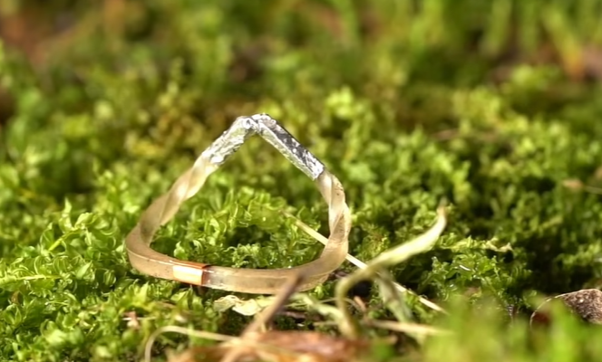
Researchers at North Carolina State University have demonstrated a much simpler alternative. Their teardrop-shaped “ring leaper” uses infrared light to repeatedly twist, release and reset itself, allowing it to continue jumping for as long as the light remains present.
The robot consists primarily of a ribbon made from a liquid crystal elastomer, a flexible material that changes shape in response to heat. The ribbon is formed into a teardrop, with a stiff, V-shaped aluminum tube attached at one end.
According to TechXplore, when infrared light shines on the robot, the exposed surface of the elastomer contracts. That contraction causes the ribbon to rotate, but the rigid aluminum V prevents the entire structure from simply rolling across the ground.
Instead, the ribbon begins to twist and store elastic energy, much like winding a spring. Once the torsion reaches a critical point, the structure rapidly releases that energy. The aluminum section snaps downward and strikes the surface, propelling the robot into the air.
After the jump, the ribbon naturally returns to its starting configuration. No separate motor or mechanical reset mechanism is required. If infrared illumination continues, the same cycle begins again.
Researchers found that surprisingly small geometric changes determine how the robot moves. With the aluminum V opened to approximately 120 degrees, the device crawls rather than jumps. At 90 degrees, it leaps forward, while narrowing the angle to about 50 degrees produces a mostly vertical jump.
Adding a small weight to the rounded end can shift the center of mass and increase forward jumping distance. Light intensity also matters: too little infrared energy will not trigger the mechanism, while excessive illumination can produce unstable and unpredictable jumps.
In proof-of-concept experiments, the robots successfully crossed slopes and hurdles and moved over grass, sand, rocks and mulch, demonstrating that the mechanism can function on surfaces considerably less predictable than a laboratory floor.
The technology does not currently have a specific operational application. However, the researchers identify swarm robotics, environmental exploration and navigation across unstructured terrain as possible directions.
Those characteristics could eventually have relevance for defense and emergency response. Small, inexpensive robots capable of crossing rubble, vegetation or other irregular surfaces could potentially carry miniature sensors into areas that are difficult or unsafe for people to enter. Significant development would still be required to add navigation, sensing and practical power or illumination systems.
For now, the main advance is mechanical: a soft robot that turns continuous light into repeated jumps without requiring a complicated actuator to prepare it for the next one.
The research was published here.