This post is also available in:
 עברית (Hebrew)
Detecting small drones often requires sensors to be positioned close enough to likely flight paths to pick up their signals. On a battlefield, however, the best location for a sensor may also be one of the worst places to put its operator. Forward positions can be exposed to enemy fire, electronic warfare, and the drones the system is intended to detect.
A recent military demonstration tested a different approach: put the counter-drone equipment on a robot and send the sensor forward without the soldier.
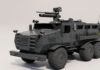
During the U.S. Army’s Project Convergence-Capstone 6 experimentation campaign, L3Harris Technologies and ARX Robotics integrated the CORVUS-RAVEN counter-UAS system onto a GEREON uncrewed ground vehicle. The combination was used to explore how mobile robotics could extend drone detection into hazardous areas while personnel remained farther away.
The system primarily uses passive radio-frequency sensing. Instead of transmitting radar energy, it listens for signals associated with unmanned aircraft and their communications. When relevant activity is detected, the system can provide bearing information indicating the direction from which the signal is coming.
Mounting that equipment on the UGV makes the sensor mobile. Operators can remotely position the robotic vehicle closer to suspected drone approaches or relocate it as the tactical situation changes, rather than establishing a fixed sensor site and placing personnel alongside it.
Information collected by the system can also be shared beyond the robot itself. The system produces TAK-compatible messages, allowing detections and bearing information to feed into Tactical Assault Kit-based command-and-control applications. Personnel elsewhere could therefore see the reported threat information within a shared geospatial operating picture.
According to Interesting Engineering, the system can additionally provide an integrated electronic defeat capability, potentially allowing the same system to move beyond detection and electronically interfere with a drone threat without requiring separate external equipment.
The demonstration also highlights the role of modularity. The UGV was designed as a robotic carrier for different mission payloads, while the system uses an open architecture intended to simplify integration with other systems. Combining the two therefore did not require developing a dedicated counter-drone vehicle from scratch.
That approach could become increasingly useful as small UAVs spread across the battlefield. Counter-drone coverage may need to move rapidly with ground forces, while sensors positioned too far behind the front could leave gaps in awareness.
The project provided a test environment for examining whether robotic vehicles can help close those gaps. The broader concept is straightforward: if a sensor needs to move closer to a dangerous area to detect the threat, the equipment can take the risk instead of the person operating it.