This post is also available in:
 עברית (Hebrew)
Air-defense radars face an inherent problem: the signals they transmit to find aircraft can also reveal where the radar itself is located. In a contested environment, those emissions can make sensors targets for electronic warfare or weapons designed to home in on radar activity. Keeping watch while transmitting less is therefore becoming an important part of air-defense survivability.
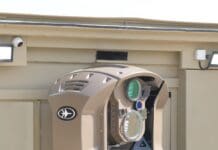
A recent exercise demonstrated how passive radar can become part of a wider networked air-defense system. During the German Air Force’s Timber Express 2026 exercise, Hensoldt’s Twinvis passive radar was integrated with Rheinmetall’s Skymaster command-and-control system, which was directing a Skynex air-defense battery.
Unlike conventional active radar, the radar does not illuminate targets with its own radio transmissions. Instead, it detects how existing signals from other transmitters are altered or reflected by objects moving through the airspace. By analyzing those signals digitally, the system can detect and track aircraft without producing the distinctive emissions of a conventional radar.
During the exercise, it generated an air picture that was fed into the C2 system, where its tracks could be combined with information from other sensors. The integration took place under NATO networking conditions using Link 16, a tactical data network that allows participating platforms to exchange track and situational-awareness information.
The result was a common air picture built by correlating observations from different sources rather than depending on a single radar.
According to Interesting Engineering, the C2 system is designed to combine active radar, passive radar and electro-optical sensors within the same command architecture. Each provides different advantages: active radar can offer precise independent detection, passive systems can monitor without transmitting, and electro-optical sensors can visually or thermally observe targets without producing radio-frequency emissions.
Combining them can make the network more resilient. A military unit could reduce active radar transmissions under an emissions control, or EMCON, strategy while continuing to receive information from passive sensors elsewhere in the network. Active radars could then potentially be used selectively when additional information is required.
That approach is particularly relevant to protecting critical infrastructure, mobile formations and air-defense positions. Distributed sensors also make it harder for an adversary to neutralize surveillance by locating and attacking a single prominent radar.
The demonstration showed the radar detecting and tracking aerial targets while its information contributed directly to an operational air-defense picture. The companies say the integration could provide a foundation for adding passive sensing to stationary battery, mobile Skyranger and counter-UAS architectures such as Skyspotter.
The broader change is architectural rather than simply technological. Future air defense increasingly depends on many sensors sharing what each can see. Passive radar adds another source to that network – one capable of watching the airspace while making considerably less electromagnetic noise of its own.