
This post is also available in:
 עברית (Hebrew)
Written By Or Shalom
The DroneX 2026 exhibition at ExCeL London marks a clear turning point in the evolution of unmanned systems and airspace defense [1]. Bringing together hundreds of leading companies, integrators, and technology experts from around the world, this year’s event serves as a sharp operational and industrial barometer of a changing security and geopolitical landscape. The center of gravity has shifted decisively toward dual-use technologies, low-altitude airspace defense (C-UAS), protection of critical national infrastructure, and uncompromising operations in threatened and electromagnetically disrupted environments (Contested Environments).
The direct interaction in London between policymakers, law enforcement and security agencies, DefenseTech leaders, and hardware manufacturers demonstrates that the industry is increasingly being measured by battlefield survivability, sustainable wartime economics, and proven operational effectiveness.
Eastern markets, and China in particular, demonstrate the extent of the West’s deep dependence on core components manufactured in Asia. Even when an exhibitor presents a Western platform, a quick technical look under the hood often reveals an industrial ecosystem relying almost entirely on Chinese-made Tier-2 and Tier-3 components. These range from motors and electronic speed controllers that form the backbone of tactical platforms, through power solutions and high-discharge battery cells whose mass-production capacity is concentrated in Asia, to carbon-fiber frames, aerospace-grade aluminum components, and mechanical modules offered at prices that domestic manufacturers struggle to match.
A closer examination of the ecosystem displayed on the exhibition floor reveals a tangible operational and technological tension [2]. On the one hand, low-altitude threats have become more accessible, lethal, and autonomous than ever before. On the other, traditional defense and manufacturing models are proving too slow and costly to keep pace with the rapid iteration cycles of the modern battlefield.
This review analyzes the current landscape through three complementary vectors that are shaping the future of the industry. The first examines the structural transformation of the sector – the shift toward low-cost, attritable platforms produced at speed, including through 3D printing, alongside open command-and-control architectures. The second explores the Russia-Ukraine effect as a catalyst that has reshaped requirements for resilience, autonomous navigation, and operational training. The third charts the inevitable rise of hard-kill and kinetic interception solutions as reliance on electronic jamming alone proves increasingly insufficient.
The Shift Toward Low-Cost Attritable Systems, Rapid Manufacturing, and Open C2 Architectures:
The industrial dynamics evident across the exhibition floor point to a profound paradigm shift in defense development and procurement. The traditional model, based on complex, high-cost platforms with development cycles spanning years, is proving increasingly unsuitable for an environment characterized by extreme operational attrition. In its place, a new approach centered on attritable systems, which are platforms whose cost makes their loss during a mission acceptable while still delivering clear lethal or intelligence-gathering effectiveness, is taking hold.
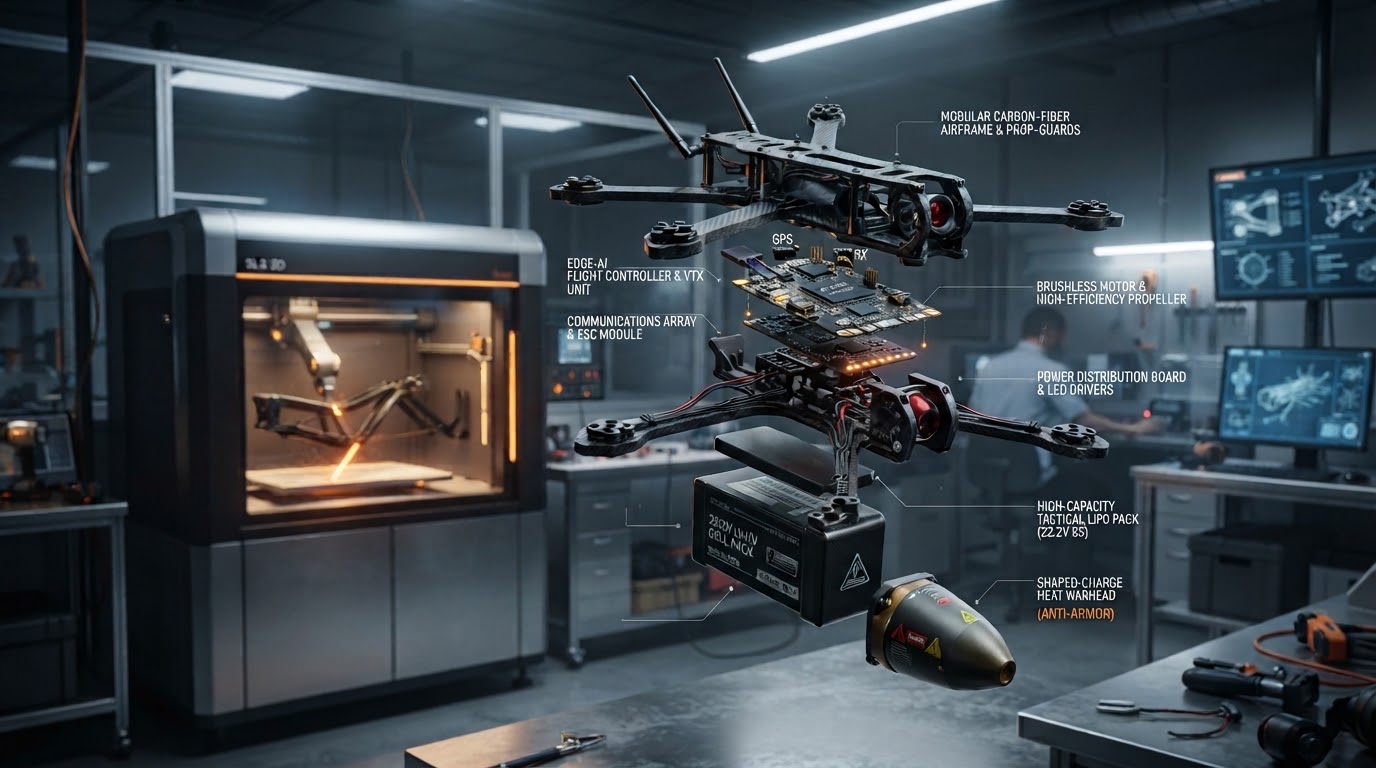
This transition is being driven first and foremost by the revolution in rapid, distributed production using additive manufacturing and carbon-fiber composites. These technologies have evolved from prototyping tools into genuine serial-production capabilities, enabling a transition from CAD design to an operational flight-ready component within hours. At the same time, they dramatically reduce unit costs and enable distributed print farms to be established on demand close to the front line, reducing dependence on vulnerable supply chains.
In parallel, the industry is increasingly adapting civilian off-the-shelf components for tactical applications (COTS-to-Tactical), including commercial motors and electronic speed controllers that undergo sealing and environmental hardening. In this environment, where the drone airframe itself is becoming a low-cost, commoditized, and expendable product, the technological and commercial center of gravity is shifting toward software and command-and-control.
The adoption of open C2 architectures enables plug-and-play integration into a unified air picture, allowing different capabilities and solutions to be fused within a common operational framework. Meanwhile, miniaturized edge-processing chips (Edge AI) provide drones with optical tracking and local closed-loop capabilities without relying on congested communications links.
The combination of mass production, flexibility, and low cost, managed through an advanced software and C2 layer, is becoming an essential foundation both for saturating the battlefield with strike and intelligence-gathering assets and for fielding maneuvering target drones for realistic training at a sustainable cost [3].
This trend is becoming even more pronounced amid current global market forces. While Western defense budgets are rising to historic highs, bottlenecks in traditional heavy defense industries, characterized by lead times of several years for the delivery of conventional defense systems and platforms, have created a critical supply gap. This reality is accelerating unprecedented capital flows from venture capital funds and government-backed investment bodies directly into agile DefenseTech ventures capable of producing thousands of units per month at costs tens of percent below conventional military standards.
The combination of unit prices of no more than a few thousand dollars and the ability to deploy cloud-based software upgrades within days via OTA (Over-the-Air) connectivity is positioning attritable platforms not merely as a tactical alternative, but as an economic backbone of emerging warfare doctrines.
The shift from centralized manufacturing to hybrid, distributed production networks demonstrates that firepower and deterrence in the low-altitude domain are no longer measured solely by mechanical sophistication. Increasingly, they are defined by the ability to saturate the battlespace rapidly, at scale, and at a cost that strains an adversary’s economic and operational resources.
The Russia-Ukraine Effect: The Battlefield as a Development Lab, Operational Lessons, and the Impact on Ukrainian Manufacturers –
The military conflict in Eastern Europe has become the most intensive operational and technological testing ground in the history of unmanned systems, with the airspace along the front lines characterized by the simultaneous operation of tens of thousands of platforms under aggressive electronic warfare (EW), communications jamming, and continuous air-defense fire. Emerging from this environment, the operational lessons and technological solutions developed by Ukraine’s defense industry and entrepreneurial ecosystem, prominently displayed and reflected in the professional discussions at the exhibition, are setting new engineering standards for combat effectiveness and agility.
At the forefront of this transformation is the revolution in FPV drones and tactical kamikaze drones, which have evolved from civilian sports and racing platforms into precision weapons costing only a few hundred dollars and capable of striking vulnerable points on armored vehicles, whether stationary or moving, as well as command posts and communications infrastructure with high precision.
This process has demanded exceptional engineering creativity, ranging from the development of 3D-printed arming and release mechanisms and dynamic frequency changes during combat, to the breakthrough introduction of fiber-optic-guided drones, which provide immunity to RF jamming while transmitting clear video without an RF emission signature that can be detected and geolocated.
At the same time, the need to operate against intensive jamming has accelerated the integration of Edge AI modules by Ukrainian companies for optical terminal guidance, enabling precise strikes even when communications and video links are completely lost during the final seconds of flight. These capabilities are complemented by autonomous navigation mechanisms (A-PNT) based on machine vision and terrain recognition, designed to maintain operation in fully GPS-denied environments.
This approach has not remained limited to attacks against ground targets. It has also expanded into the kinetic aerial interception of larger reconnaissance drones, laying the tactical foundation for drone-on-drone warfare (as discussed in greater detail below).
Moreover, accumulated operational experience has demonstrated that hardware availability alone is insufficient without skilled personnel, leading to the emergence of an entirely new market: dedicated academies and training centers for thousands of drone operators, field engineers, and instructors. These training frameworks, combining advanced simulators for flight under severe jamming conditions with Red Teaming methodologies, have opened up an entirely new market and become a sought-after form of strategic expertise for militaries and security organizations worldwide seeking to incorporate lessons from the battlefield into the defensive and offensive doctrines of the future.
The Rise of Hard-Kill Solutions and the Shift Toward AI-Driven Kinetic Interception:
One of the key conclusions gaining traction at the exhibition is that soft-kill technologies (frequency jammers, RF disruption, and passive electronic warfare) are reaching an operational ceiling. The rapid development of fully autonomous platforms powered by Edge AI-based image processing, the shift toward pre-programmed flight paths with no RF emissions, and the growing use of fiber-optic control links that are entirely independent of wireless communications have made traditional jamming methods increasingly ineffective against modern threats.
This reality has forced the industry toward a sharp and increasingly unavoidable shift to hard-kill solutions and direct kinetic interception, enabling threats to be physically neutralized in the air. At the core of this response are interceptor drones, dedicated unmanned platforms designed specifically for aerial interception.
These interceptor drones are characterized by extreme kinematic performance, including flight speeds of 200–300 km/h or more, exceptionally rapid vertical acceleration, and reinforced carbon-fiber structures capable of withstanding high G-loads. Platforms in this category range from low-cost FPV interceptor drones (including concepts using fragmentation warheads or direct-impact interception) to advanced turbojet-powered interceptors manufactured rapidly to engage high-speed targets.
The technological breakthrough enabling these interceptors to succeed lies in the integration of artificial intelligence (AI) for edge-based fire-control loop closure. Given the high flight speeds and short engagement distances during the terminal phase, human reaction time is no longer sufficient. Miniaturized AI modules installed onboard the interceptor perform optical detection, autonomous target lock, and dynamic lead-pursuit calculations, guiding the aircraft toward a precise hit-to-kill engagement even under complete communications loss.
This combination, implemented through open C2 architectures that connect early-warning sensors with autonomous launch systems, is transforming hard-kill technology from a specialized, complex solution into an essential layer of defense. It enables security and defense systems to counter swarms and autonomous aerial threats in highly contested airspace without expending costly strategic munitions.
The DroneX exhibition provides another clear indication that the low-altitude domain is becoming an increasingly contested environment saturated with electronic warfare. This reality demands a fundamental operational and industrial paradigm shift: the model of heavy, expensive platforms is giving way to attritable systems produced rapidly through distributed manufacturing, reducing dependence on vulnerable supply chains while maintaining economic viability amid battlefield attrition.
At the same time, the integration of lessons from the war in Eastern Europe, from the adaptation of FPV drones and the development of resilient navigation solutions to the establishment of dedicated training academies, demonstrates that adaptive agility has become a prerequisite for operational survival.
As electronic jamming systems (Soft Kill) reach their operational ceiling, the industry is inevitably shifting toward kinetic countermeasures (Hard Kill) that combine high-speed interceptors with Edge AI for autonomous fire-control loop closure. Market forces and operational constraints are therefore driving the industry toward a balance between flexible mass production, open C2 architectures, and precise engagement capabilities.
The author is an expert in security, DefenseTech, HLS, and cybersecurity, and serves as a consultant to government ministries, defense industries, and the private sector. He holds a master’s degree as well as government and civilian certifications in the fields of security and cybersecurity. His work includes consulting and business development for defense and security organizations and companies in areas such as defense planning and development, security innovation and technology, and specialized security training, including a dedicated course on low-altitude airspace security and countering drone threats to critical infrastructure and sensitive facilities.
[1] https://dronexpo.co.uk/showguide
[2] https://dronexpo.co.uk/exhibitor-list
[3] https://www.csis.org/analysis/calculating-cost-effectiveness-russias-drone-strikes