
This post is also available in:
 עברית (Hebrew)
Getting ammunition, equipment and medical supplies to frontline troops is often one of the most dangerous parts of military logistics. The final stretch between supply points and combat positions can expose soldiers to enemy fire, while evacuating wounded personnel requires additional manpower in areas where every minute matters.
The U.S. Army is exploring autonomous ground vehicles to reduce those risks, selecting six companies to develop robotic platforms capable of transporting supplies and casualties across difficult battlefield terrain.
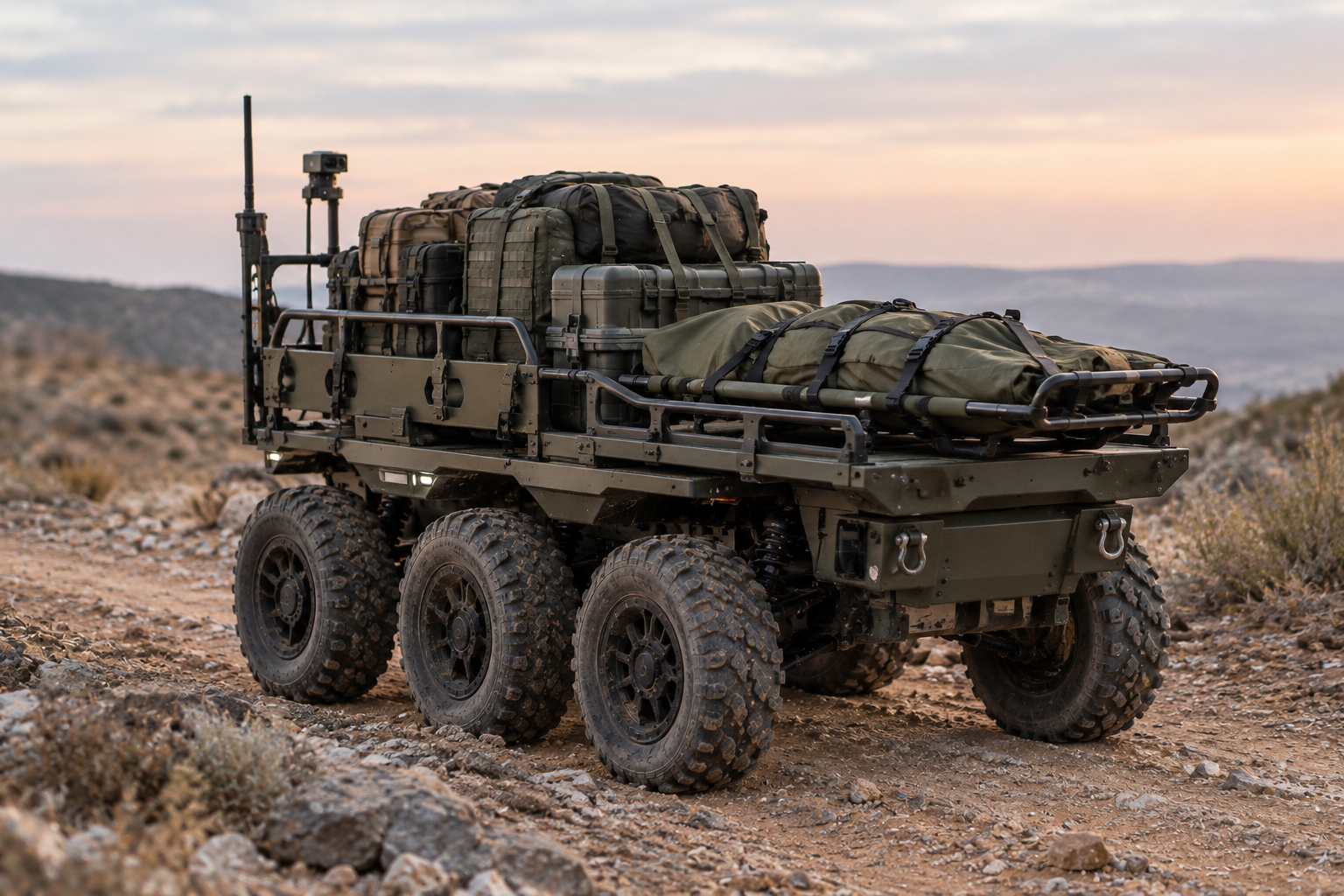
Among the candidates is Hunter WOLF, a six-wheeled unmanned ground vehicle developed by BLADE. The diesel-electric hybrid is designed to accompany infantry units and carry heavy loads without requiring soldiers to drive it.
According to Interesting Engineering, the UGV can transport up to 1,270 kilograms autonomously. Its six-wheel configuration allows it to navigate demanding terrain, including dense forests, slopes with a 60% grade and side slopes of up to 40%.
That mobility is particularly important for dismounted infantry, whose operating areas may be inaccessible to conventional supply vehicles.
The platform is also designed for multiple missions. Its modular configuration allows it to carry ammunition and equipment or support casualty evacuation, while its onboard power system can supply electricity to other military equipment.
The UGV is not an entirely new prototype. The company describes it as a Technology Readiness Level 9 (TRL 9) system, indicating that it has already been demonstrated in operational conditions.
The vehicle has reportedly participated in more than 60 military field exercises since entering service in 2017, receiving further upgrades in 2025. The company says it has supported American, Australian and Ukrainian military forces.
During 2026, the UGV also underwent evaluations with several U.S. Army formations. Soldiers from the 10th Mountain Division received vehicles for training in operation and maintenance, while additional assessments involved the 101st and 82nd Airborne Divisions.
The latest evaluation is part of the Army’s Infantry Last Tactical Mile (ILTM) initiative, which is examining different autonomous solutions for frontline logistics.
Six companies are participating in the competitive prototype program, with demonstrations and an operational assessment expected in early 2027. The Army will use those results to refine its requirements and consider future production.
No vehicle has yet been selected for Army-wide deployment.
The broader objective is to change how infantry units handle the most exposed part of their supply chain. If autonomous vehicles can reliably cross difficult terrain while carrying heavy cargo or evacuating casualties, soldiers could spend less time transporting equipment through dangerous areas and more time carrying out their primary missions.