
This post is also available in:
 עברית (Hebrew)
Moving supplies or wounded personnel across the battlefield can expose soldiers to mines, artillery, drones and direct fire. Ground robots offer a way to remove people from some of those journeys, but they face another challenge: the terrain itself. Potholes, rocks, debris and fallen trees can quickly stop a vehicle that depends on smooth roads.
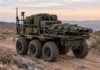
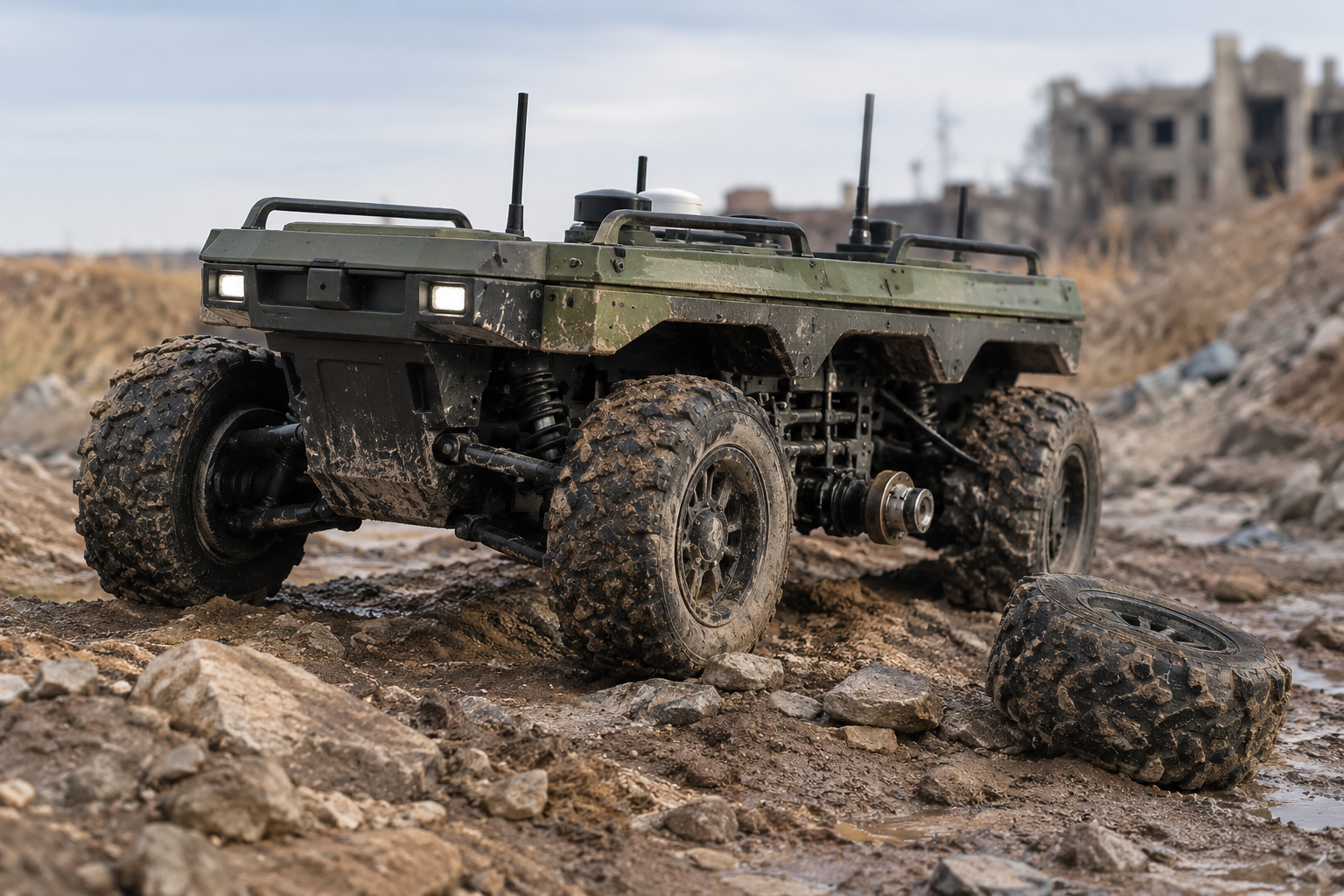
A new six-wheeled unmanned ground vehicle called Frodo is designed to keep moving through those conditions while taking on logistics, evacuation and combat missions.
Developed by Ukrainian aerial-drone manufacturer Frontline Robotics, the UGV uses a 6×6 chassis with adaptive independent suspension. Each wheel can respond to terrain individually, helping the vehicle remain stable as it crosses uneven surfaces and obstacles.
Its low center of gravity further reduces the risk of instability. More unusually, the UGV incorporates redundant mobility, allowing it to continue operating if one of its six wheels is damaged or destroyed.
According to NextGenDefense, that resilience could be particularly valuable when the robot is carrying supplies or evacuating a casualty from an exposed area, where stopping because of a single damaged wheel could leave both the platform and its payload stranded.
The UGV can carry up to 400 kilograms and travel as far as 150 kilometers, with a maximum speed of 40 km/h. Depending on the mission, that capacity can be used for ammunition, equipment, supplies or casualty transport.
The platform is also modular enough to move from support roles into armed operations.
Available payloads include the company’s Buria robotic turret, an automatic grenade launcher or a heavy machine gun, allowing the same underlying vehicle to provide mobile fire support when required.
Communications can be configured around different operational networks. The UGV supports Starlink, LTE, Silvus and other tactical communications modules, giving operators several options for maintaining connectivity.
For situational awareness, two day/night cameras are fitted as standard. Two additional thermal cameras can be added for missions requiring improved visibility in darkness or difficult conditions.
The vehicle has also been designed with field maintenance in mind. Its batteries can be replaced by a single operator, reducing the personnel needed to return the system to operation.
The UGV has already been codified for use and is undergoing training exercises with Ukrainian soldiers ahead of battlefield deployment.
The platform reflects a broader shift in military robotics. Unmanned systems are moving beyond specialized reconnaissance roles and becoming general-purpose machines that can carry cargo, evacuate casualties or weapons depending on what the mission requires.
For the UGV, the central idea is straightforward: if a robot is being sent into terrain considered too dangerous for soldiers, it needs to remain useful even when that terrain, or enemy action, starts damaging the machine itself.