This post is also available in:
 עברית (Hebrew)
Apco Aviation Defense is a graduate of the INNOFENSE Innovation Center operated by iHLS in collaboration with IMoD. This unique acceleration program removes entrance barriers to the technological ecosystem, turning startups into mature, leading companies while connecting them with relevant investors, which is designed to strengthen the links between the civilian and defense markets via the collaborative development of the technologies, thus advancing and improving their integration in both markets.
Unmanned aerial systems have become indispensable across the modern battlefield. As these platforms grow more sophisticated, valuable, and sensitive, so does the need to recover them safely after every mission. Drones, UAVs, loitering munitions, and airborne payloads, which all use parachutes for recovery operations during both routine missions and emergencies, can all be damaged during landing, particularly when operating without landing gear, at low altitudes, or in scenarios requiring ultra-fast deployment of parachutes. An uncontrolled landing can result in the loss of an expensive platform, damage to sensitive payloads, and even risks to military personnel or civilians.
Apco Aviation Defense’s solutions are built on more than five decades of expertise in the sports aviation industry. The company began by developing hang gliders and ultralight aircraft, before expanding into paragliders, emergency parachutes, powered flight systems, and other advanced textile-based aerospace platforms. In recent years, it has transferred this accumulated knowledge to the defense sector in response to requests from industries seeking a local supplier with advanced development and manufacturing capabilities. Its origins in sports aviation are more than just part of its history—they are the foundation of its engineering advantage. In sports aviation, parachutes and soft-wing canopies must be lightweight and compact while maintaining exceptional stability, aerodynamic efficiency, and glide performance. Those same design principles are now being applied to defense technologies, where reducing weight and volume, improving aerodynamics, and enabling precise glide paths directly enhance platform range, payload capacity, and safe recovery.
Rather than offering off-the-shelf products, the company’s primary strength lies in its engineering and development capabilities. The company provides complete turnkey solutions, from initial concept and design through serial production, developing mission-specific systems tailored to each customer’s operational requirements—especially when no comparable product exists on the market. Keeping every stage of development and manufacturing under one roof enables tighter quality control, shorter development cycles, and greater flexibility throughout the process.
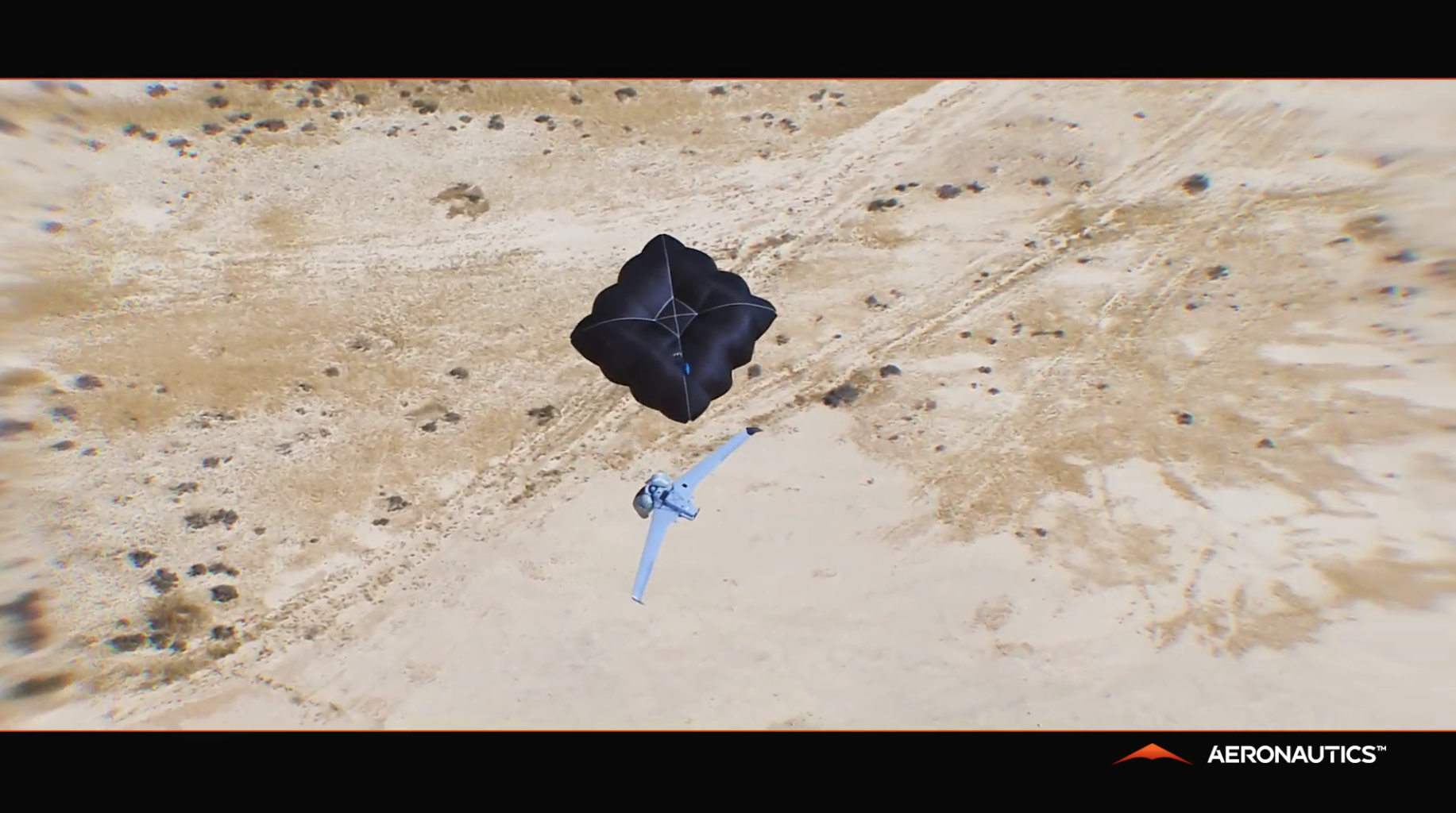
One of the company’s core product families includes recovery parachutes for controlled descent of payloads, aerial platforms, and personnel, covering payloads ranging from just one kilogram to well over one ton. Alongside these are Ram-Air parachutes, designed as soft wings with upper and lower surfaces that inflate during flight. Unlike conventional parachutes that simply slow a vertical descent, the systems can glide, maneuver, and execute far more controlled landings. This enables operators to steer a platform away from hazardous areas, guide it toward a designated landing zone, and significantly reduce landing impact.
The company’s technologies also include rapid deployment systems for missions requiring extremely short response times. Mechanisms such as reefing systems and sliders regulate the parachute’s opening sequence, reducing opening shock that could otherwise damage the aircraft or its payload. For high-value UAVs, drones, and loitering munitions, the company also develops inflatable airbags that deploy just before touchdown to absorb landing energy. Additional solutions include recovery nets, release mechanisms, super-pressure balloons, and specialized textile systems for aerospace, defense, and industrial applications.
A key technological advantage comes directly from the company’s sports aviation heritage. In that field, weight, packed volume, glide performance, and aerodynamic efficiency are critical design parameters. A parachute must be light enough to carry while still generating lift, maintaining stability, and flying efficiently without propulsion. The expertise gained in designing soft-wing canopies and lightweight textile structures is now being applied to military platforms, where reducing weight and volume can extend operational range, increase payload capacity, and improve survivability. Years of high-volume manufacturing for the sports aviation market have also enabled the company to streamline production, allowing it to deliver high-performance systems at costs that remain competitive with international manufacturers.
Another significant link between the technology and operational defense requirements was established through INNOFENSE, the iHLS Innovation Center operating in collaboration with Israel’s Ministry of Defense, the Directorate of Defense Research & Development (DDR&D), and the Israel Defense Forces. As part of one of the program’s technology challenges, participants were asked to develop an automated system for handling and packing parachutes used by mini-UAVs. While the parachutes themselves already existed, the folding process remained manual, time-consuming, and highly dependent on operator skill. These platforms are designed to operate in swarms of dozens or even hundreds simultaneously, making the rapid restoration of operational readiness after each mission a significant challenge.
In response, the company developed an automated parachute folding system that reduces folding time by approximately 95%. The innovation delivers far more than time savings: it improves folding consistency, minimizes human error, and returns unmanned systems to operational readiness much faster. For military units operating large UAV fleets, this can significantly reduce maintenance workload while increasing platform availability for subsequent missions.
The INNOFENSE project effectively expands the company’s offering from a standalone product into a complete recovery solution—combining a recovery parachute with an automated system that prepares it for its next deployment. Upon completion of the program, the company expects to become the first supplier capable of delivering such an end-to-end solution, covering everything from aerodynamic parachute design and manufacturing to platform integration and automated repacking after use.
Since 2015, the company’s defense division has been led by CEO and owner Jonathan Cohn, who spearheaded the company’s expansion into the defense market. He is joined by company founder Anatoly Cohn, who continues to serve as an advisor, a dedicated team of six defense engineers, and specialists in physics, aviation, and manufacturing. Together, they continue transforming decades of expertise in light aviation into advanced technologies designed to meet the evolving operational demands of modern defense.