

This post is also available in:
 עברית (Hebrew)
Organizations responsible for logistics, infrastructure, and critical facilities are increasingly required to inspect, map, and monitor enormous areas — sometimes hazardous or inaccessible — without relying on large human teams. Existing ground robots often struggle to combine stability, environmental awareness, and long operational range, leaving a technological gap that limits wider deployment of autonomous systems.
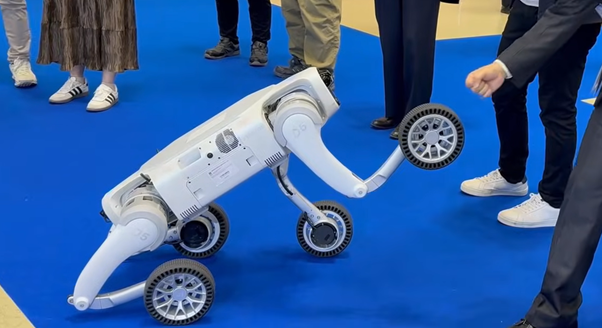
The newly introduced D5 robot, unveiled at the iREX exhibition in Tokyo, is designed to close that gap. Standing nearly one meter tall, the quadruped combines legged mobility with a wheeled mode, allowing it to move confidently on stairs and uneven surfaces while still maintaining efficient travel across open floors and long corridors. Its dual-processor architecture, based on NVIDIA Orin and RK3588, delivers roughly 275 TOPS of computing power dedicated to real-time SLAM, obstacle avoidance, object recognition, and navigation without operator input.
According to Interesting Engineering, one of the system’s most notable capabilities is its ability to map and autonomously navigate areas of up to one million square meters — the scale of industrial zones, warehouses, or multi-site facilities — and conduct continual inspection routes of up to 14 kms. The perception suite combines four 120° fisheye cameras for full 360° coverage with high-resolution front and rear LiDAR units that generate dense 3D point clouds, giving the robot a detailed spatial understanding of its surroundings.
Durability is central to the design: the robot uses a reinforced aluminum structure, closed-loop torque control, and can carry up to 30 kilograms for over two hours. It is also IP67-rated and built to operate in temperatures ranging from –20°C to 55°C, enabling deployment in harsh outdoor or industrial environments.
Although introduced in a civilian robotics context, the robot’s capabilities align closely with emerging security and defense needs. Autonomous ground platforms with long-range endurance, advanced sensing, and safe navigation can support perimeter monitoring, patrols in hazardous zones, inspection of sensitive infrastructure, and ground-level intelligence collection — tasks that traditionally require significant manpower.
The robot illustrates a broader shift in robotics toward versatile, terrain-capable platforms supported by stronger on-board computing and perception. These developments are gradually expanding the range of missions in which autonomy can reliably replace or augment human operators.























