This post is also available in:
 עברית (Hebrew)
Military systems are becoming increasingly sophisticated, but the person operating them still needs a practical way to control what is happening. Complex interfaces can increase training requirements and cognitive workload, particularly when operators need to make decisions quickly.
One solution is coming from an industry that has spent decades solving a similar problem: gaming.
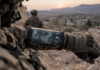
U.S. forces are reportedly using a reconfigured Xbox-style controller to operate laser weapon systems deployed in the Strait of Hormuz. According to NextGenDefense, reported targets include Iranian drones and missiles, although the U.S. Department of Defense has not independently verified the engagement details.
The controller uses two analog sticks and a familiar arrangement of buttons, giving operators an interface based on controls already refined for gaming.
Behind that interface is a considerably more complicated weapon.
A laser system draws electricity from generators or batteries and converts it into a concentrated beam. Sensors and software detect and track the target, while the system must keep the beam accurately positioned long enough to transfer sufficient energy to damage the object.
The controller provides the human interface to that process, allowing the operator to steer the weapon and make adjustments while automated systems handle other parts of tracking and engagement.
Its use illustrates a broader connection between gaming and defense technology. Modern games have driven development in intuitive controls, real-time 3D environments, graphics engines, networking and the coordination of multiple players inside the same digital world. Many of those capabilities can be useful well beyond entertainment.
One particularly relevant area is military training.
Technology originally designed to let multiple players participate in the same game can form the basis of a shared virtual training environment. Using game engines, distributed simulation and VR or AR, several soldiers or teams can potentially operate inside the same scenario in real time, seeing one another’s actions and responding to changing conditions.
Such systems can complement field exercises by allowing forces to repeatedly practice scenarios that would be expensive, dangerous or difficult to reproduce physically. A simulated environment can also be changed quickly, enabling personnel to rehearse different threats, terrain and operational situations without rebuilding a real training site.
The Xbox-style laser controller is therefore one visible example of a much larger opportunity: gaming technology can become defense technology when the underlying capability solves a military problem.
That opportunity is relevant to the seventh cycle of INNOFENSE, the innovation program operated by iHLS in cooperation with the Israeli Ministry of Defense and DDR&D (MAFAT). Developers of multiplayer gaming, simulation, VR/AR, or related technologies may already possess building blocks that could be adapted into collaborative training systems for defense users.
A technology built to put players into the same virtual mission could ultimately put soldiers there instead, with the opportunity to develop and demonstrate a POC together with the defense establishment.
Are you working on a technology that might relate to gaming/VR/AR and think it might be able to apply to military training/simulation? Apply to INNOFENSE now!