

This post is also available in:
 עברית (Hebrew)
Firefighters frequently operate in environments where collapsing structures, intense heat, toxic smoke, and rapidly changing conditions pose significant risks. Entering these areas to extinguish fires or assess hazards can expose emergency crews to life-threatening situations, driving growing interest in robotic systems that can perform some of these tasks from a safe distance.
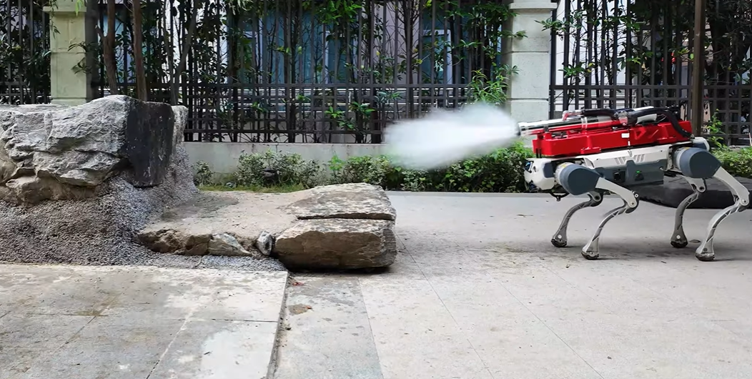
A newly demonstrated quadruped robot (by DEEP Robotics) has been developed specifically for that purpose. Designed for remote firefighting operations, the robot combines advanced mobility with a pulse-based fire suppression system intended to extinguish flames while keeping human responders away from the most hazardous areas.
Unlike conventional firefighting equipment that continuously sprays large volumes of water or foam, the system delivers short, high-energy pulses directed precisely at the fire. This approach aims to suppress flames efficiently while reducing water consumption and limiting damage to surrounding equipment or structures.
According to Interesting Engineering, the robot is operated remotely, allowing firefighters to maintain a safe stand-off distance while accurately targeting the source of the fire. Its mobility enables it to reach areas that may be inaccessible or unsafe for personnel.
The firefighting system is built on the company’s X30 quadruped platform, which was developed for industrial inspection and emergency response. The robot can climb stairs with slopes of up to 45 degrees, traverse uneven terrain, negotiate loose gravel, sand, wet surfaces, and industrial flooring, and step over obstacles while maintaining stability.
Navigation relies on a combination of LiDAR, depth cameras, infrared sensors, and high-resolution optical cameras. These sensors work together to generate three-dimensional maps, detect obstacles, and support autonomous movement even in smoke, darkness, or rapidly changing lighting conditions.
The robot also features an improved battery system that extends operating time while allowing depleted batteries to be replaced quickly without tools, reducing downtime during extended emergency operations.
From a defense and homeland security perspective, robotic firefighting systems have applications beyond municipal emergency response. Similar platforms could support military bases, ammunition storage facilities, critical infrastructure, chemical plants, energy installations, and disaster-response missions where hazardous conditions make direct human intervention particularly risky.
The firefighting robot is also part of a broader robotic response ecosystem that includes water-cannon robots, aerial drones, and autonomous ground platforms sharing information through real-time communications and three-dimensional mapping. Together, these systems illustrate how autonomous robotics are becoming increasingly capable of supporting emergency responders in environments where speed, situational awareness, and personnel safety are equally critical.























