

This post is also available in:
 עברית (Hebrew)
Collecting data in the Arctic is often as challenging as the research itself. Beneath seemingly solid snow can lie hidden pools of icy water, unstable ice layers, and terrain that changes constantly with weather conditions. These hazards make field operations expensive, slow, and potentially dangerous for scientists and rescue personnel working in remote polar regions.
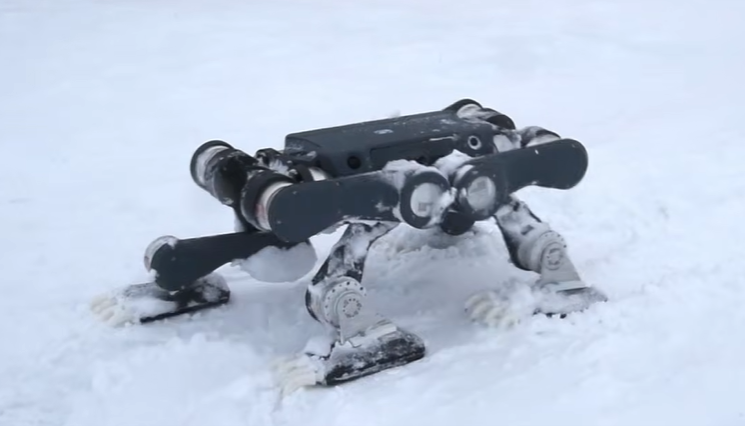
Researchers recently tested a new approach: sending a compact autonomous quadruped robot into environments that humans would rather avoid. During an Arctic expedition, a modified version of the Lynx S10 robot successfully traversed Arctic Ocean ice floes, becoming the first four-legged robotic platform reported to operate in these conditions.
The robot was designed around autonomous navigation and terrain adaptation. Using four high-dynamic-range cameras and front-and-rear LiDAR sensors, it continuously builds a three-dimensional map of its surroundings. This allows it to identify obstacles, estimate safe routes, and navigate without requiring constant operator control.
The standard platform already offers considerable mobility. Weighing less than 20 kilograms, it can be carried and deployed by a single person. Sixteen precision joints allow it to walk, climb over obstacles up to 50 centimeters high, transition between wheeled and legged movement, and even stand upright temporarily to improve visibility.
Arctic conditions, however, required significant modifications. According to Interesting Engineering, engineers replaced the robot’s standard wheels with specially designed biomimetic paws inspired by polar bear feet. These enlarged feet distribute weight across a larger surface area, reducing the likelihood of sinking into soft snow. Anti-slip textures and integrated crampons improve traction on ice, while upgraded sealing protects the system from water intrusion.
Researchers also adapted the limbs to perform better in mixed ice-and-water environments. By increasing the effective surface area of the legs, the robot gained a paddling-like capability that helped it move through slushy terrain.
During testing, the robot encountered snow-covered areas concealing meltwater beneath the surface. Despite these challenging conditions, it maintained stability and continued navigating through environments that would be difficult for many conventional robotic platforms.
From a defense and security perspective, robots capable of operating autonomously in remote and hazardous environments have applications beyond scientific exploration. Similar technologies could support reconnaissance, environmental monitoring, disaster response, infrastructure inspection, and search-and-rescue missions in areas where human access is difficult or dangerous.
The Arctic deployment remains an experimental effort, but the performance data gathered during the mission is expected to guide future improvements to autonomous mobility in extreme environments.























