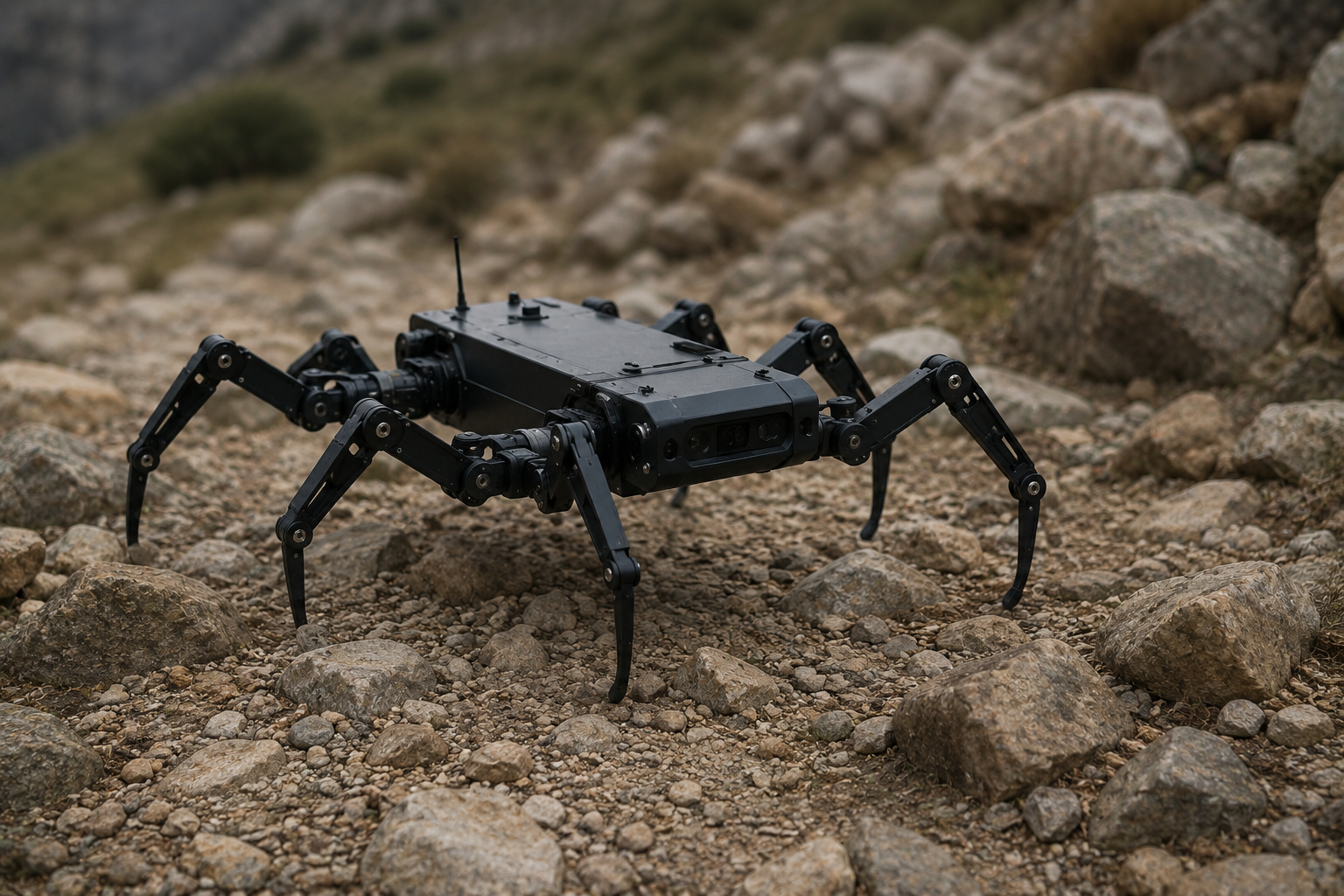
Legged robots can cross terrain that stops wheeled machines, but coordinating several legs over unpredictable ground is difficult. Many robots rely on predefined gaits, with engineers specifying when each leg should lift, move and touch down. Those patterns can work well under expected conditions but become less effective when the ground changes or a leg is damaged.
Researchers from Tohoku University and VISTEC have developed a different approach: teach a six-legged robot the principles behind a stick insect’s movement, rather than programming a fixed walking pattern.
The system was trained using movement data from the stick insect Medauroidea extradentata. Researchers recorded how 18 leg joints behaved while the insect walked on flat ground and fed those demonstrations into an AI framework based on adversarial inverse reinforcement learning (AIRL).
Instead of simply copying individual joint movements, AIRL attempts to determine the underlying “reward” that explains why the insect moves as it does. One neural network compares the robot’s behavior with biological examples, while the learning system gradually identifies movement strategies that produce similar coordinated locomotion.
That learned reward is combined with proximal policy optimization (PPO), a reinforcement-learning technique used to train the robot’s controller.
While walking, the controller continuously receives information about the robot’s body orientation, joint positions and which feet are touching the ground. It then generates commands for all 18 joints, allowing the legs to coordinate dynamically rather than following a rigid sequence.
According to Interesting Engineering, the researchers found that the resulting gait remained stable even when the environment no longer resembled the training conditions. Although the AI had learned exclusively from flat-ground insect data, the robot successfully crossed uneven terrain, automatically changing its leg timing into a more wave-like pattern while suffering only a small reduction in forward speed.
It also adapted to simulated damage. When researchers disabled one of its six legs, the controller reorganized the movements of the remaining five and redistributed the load instead of attempting to continue the original gait unchanged.
The technique also showed potential for transferring biological knowledge between different robot designs. Simply transferring the original control policy to another robot failed because its proportions, joints and motors were different. Transferring the learned reward structure, however, allowed the second machine to develop its own suitable gait substantially faster than training with a basic forward-motion reward alone.
Such adaptability could eventually be valuable in defense, emergency response and infrastructure inspection. A legged robot entering rubble, forests or damaged buildings may encounter terrain its developers could not predict, while mechanical damage could occur far from technicians.
Preliminary testing on a physical RedMirror robot produced movement resembling the simulations. The work remains experimental, but it suggests that the useful lesson from insects may not be copying exactly how they walk, it may be teaching robots why those movements work.