This post is also available in:
 עברית (Hebrew)
Protecting large industrial sites, airports, campuses and critical infrastructure often requires continuous patrols over wide areas. Autonomous security robots are increasingly being used to supplement human guards, but most rely on four-wheel designs that can be bulky, consume more energy and struggle to maneuver through narrow passages or crowded environments.
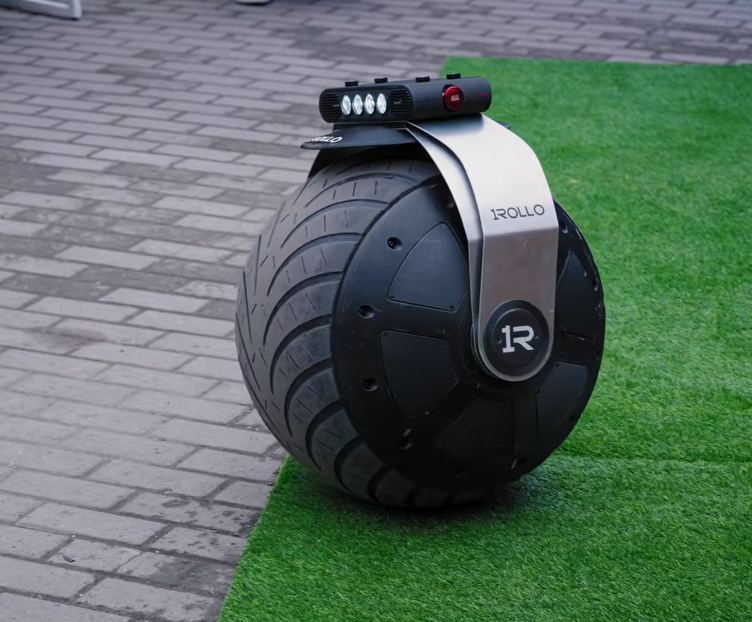
Estonian startup Rollo Robotics has introduced a different approach with 1ROLLO, an autonomous security robot that balances on a single wheel while carrying out patrol missions. According to Interesting Engineering, it is the first monowheel security robot designed for real-world autonomous operations, combining continuous surveillance with a compact, highly maneuverable platform.
The robot’s most distinctive feature is its stabilization system. Instead of using multiple wheels to remain upright, the robot relies on a high-speed gyroscopic flywheel mounted inside its main wheel. As the flywheel spins, it generates gyroscopic forces that continuously stabilize the robot while it accelerates, brakes and travels over uneven terrain. To turn, the flywheel changes its angle, allowing the robot to lean into corners in a manner similar to a motorcycle. High-frequency sensors constantly monitor its position, while onboard control software makes rapid adjustments to maintain balance, even in windy conditions.
Standing approximately 110 centimeters tall and weighing 45 kilograms, the robot can travel at speeds of up to 30 km/h. Its battery provides up to eight hours of operation before the platform autonomously returns to a wireless charging station, enabling continuous patrol cycles with minimal human intervention. An IP65-rated enclosure also allows operation in rain, dust and temperatures ranging from -20°C to 55°C.
For surveillance, the robot combines a 360-degree vision system with computer vision and edge AI, allowing it to analyze video directly onboard rather than relying entirely on cloud processing. The robot can recognize people, vehicles, open doors and other unusual activity while following pre-programmed patrol routes using an RTK-GNSS navigation system for centimeter-level positioning accuracy. When it detects an anomaly, it immediately transmits alerts over 4G, 5G or Wi-Fi, allowing operators to view live video, communicate through the robot’s microphone and speaker, or dispatch security personnel.
The platform’s modular architecture also allows additional payloads such as thermal cameras, PTZ cameras, night-vision sensors and RFID readers to be installed for different operational requirements.
Although intended for commercial security, the technology also has clear defense and homeland security applications. Military bases, logistics hubs, ports and other sensitive facilities require persistent surveillance while minimizing personnel requirements. A compact autonomous patrol robot capable of navigating confined spaces, operating in adverse weather and carrying mission-specific sensors could complement fixed security systems while providing mobile situational awareness around critical infrastructure.
Commercial deployment of the robot is planned for 2027 through a subscription-based model that includes the robot, software updates, maintenance and future hardware upgrades. The platform reflects a growing trend toward autonomous ground systems designed to provide continuous security with lower operating costs and greater operational flexibility.