This post is also available in:
 עברית (Hebrew)
Eco BRICK Innovio is a graduate of the INNOFENSE Innovation Center operated by iHLS in collaboration with IMoD. This unique acceleration program removes entrance barriers to the technological ecosystem, turning startups into mature, leading companies while connecting them with relevant investors, which is designed to strengthen the links between the civilian and defense markets via the collaborative development of the technologies, thus advancing and improving their integration in both markets.
Eco BRICK Innovio is developing a technology platform that converts locally available waste streams into engineered construction and infrastructure materials. Its work within INNOFENSE highlights a Triple-Use approach: the same technology can support civilian requirements in routine conditions, defense applications, and emergency or disaster response.
Construction and industrial waste create a twofold challenge. Large quantities of concrete, plastic, glass, gypsum, tires, and other materials are sent to landfills, while the construction and infrastructure sectors continue to consume vast quantities of new raw materials. During wars, natural disasters or other emergencies, the challenge also becomes logistical: damaged roads, fortifications, temporary structures and field hospitals may require construction materials quickly, often when conventional supply chains are constrained or disrupted. The company aims to turn locally available waste itself into a usable reserve of raw materials.
At the heart of the solution is a technology platform capable of processing more than 40 different waste streams, ranging from construction waste and mixed plastics to glass, gypsum, tires, sludge and industrial residues. The process begins with a form of “reverse engineering” of the waste: analyzing the material’s origin, composition and molecular bonds, and adapting the mixture and binder accordingly. Over the years, the company has developed a database of approximately half a million formulations, enabling different waste materials to be tailored to the properties required of the final product. The materials undergo a rapid physical process at relatively low temperatures and without combustion, resulting in an engineered material with controllable properties.
One of the platform’s principal applications is operational cold asphalt, which is made, according to the company, from approximately 95% waste. It is designed to enable rapid road repair without requiring a nearby asphalt plant or complex preparation. Tests have examined its ability to withstand heavy loads, including trucks, large forklifts and tanks. The cold asphalt was applied at the IDF’s Masha Base in Tel HaShomer, where it was tested under intensive operational traffic conditions [watch the field application video here]. Another solution is the company’s eBSM system, which enables asphalt to be milled from an existing road, mixed on-site with dedicated additives and returned to the road. According to the company, the route can be reopened to traffic approximately half an hour after compaction is completed. Such a capability can be particularly relevant when transportation and supply routes must be restored rapidly.
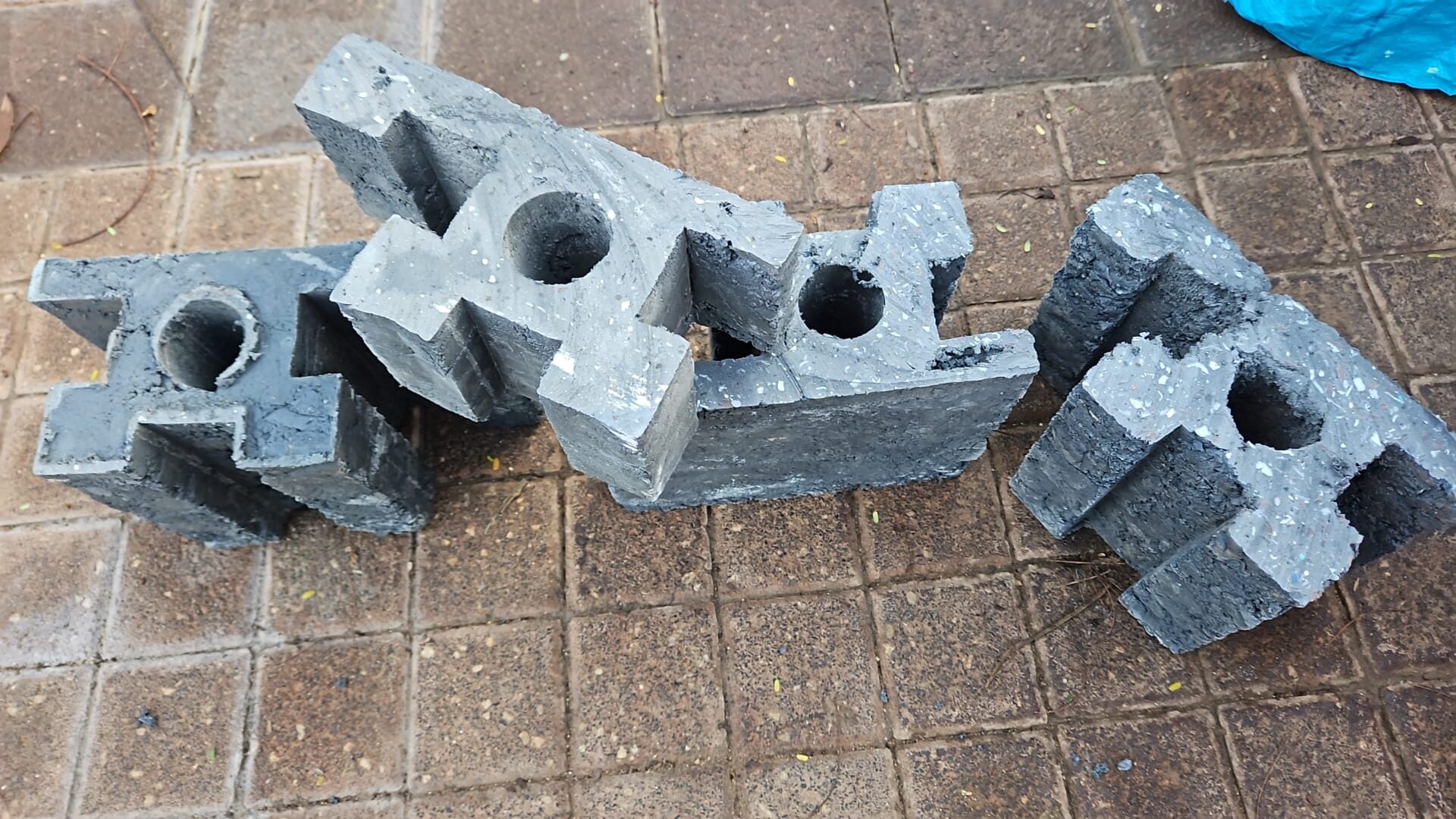
A second strategic application is rapid modular construction. The company has developed a block system made from approximately 99% waste. The blocks connect through a mechanical locking mechanism without cement, adhesives or steel reinforcement, enabling the rapid construction of fortifications, warehouses, command posts, field hospitals and temporary structures, with the option to dismantle and reassemble them elsewhere. The company has also developed flowable concrete based on recycled aggregates for filling, rehabilitation and infrastructure applications.
The company’s work through INNOFENSE also sharpened a broader defense and resilience concept: converting locally available demolition and construction waste into materials for infrastructure rehabilitation, road construction and repair, protective structures, and post-conflict or post-disaster reconstruction. In this model, waste is no longer only a logistical and environmental burden; it becomes a local resource that can be put to use in the field while reducing dependence on transported virgin materials and vulnerable external supply chains.
The figures illustrate the technology’s progress and industrial potential. The company has expanded from processing seven waste streams to more than 40, while scaling from an initial five-kilogram capacity to as much as seven tons per hour. According to company data, its asphalt additive reduces bitumen consumption by approximately 20%, while tests showed an increase in shear strength from approximately 952.54-997.90 kilograms to 3,970 kilograms. In concrete aggregate testing, a mixture incorporating the company’s aggregate weighed 1.37 tons per cubic meter, compared with 2.4 tons per cubic meter for a conventional mixture, while maintaining similar strength.
In the area of standards and validation, the company’s lightweight aggregate was tested by CTLGroup and found to meet the requirements of ASTM C331 for lightweight aggregates used in construction products. The company is also involved in projects and partnerships in Sweden, Singapore, and India. Together, the testing, scale-up and range of applications are intended to demonstrate that the technology is not solely an environmental solution, but one designed to address real-world construction and infrastructure requirements.
The company was founded in 2016 by Shlomi Perry, the company’s CEO. Since then, the technology has undergone years of research, experimentation, and development, and has evolved into a broader platform for processing diverse waste streams. The company has recently begun pursuing an investment round to support its continued development.
The Triple-Use approach captures the company’s broader vision. In routine civilian settings, waste-derived materials can support construction and infrastructure; in defense applications, they can support road rehabilitation, facilities and fortifications; and in emergencies or disasters, they can enable the rapid deployment of temporary structures, field hospitals and critical infrastructure. In this way, waste that would ordinarily be sent to landfill can become a locally available material reserve that contributes to resilient infrastructure and operational continuity.