

This post is also available in:
 עברית (Hebrew)
One of the biggest challenges facing modern military reconnaissance is persistence. Small drones provide valuable situational awareness, but they are limited by battery life, operator workload, and increasing threats from electronic warfare systems. In contested environments, GPS signals may be jammed, communications disrupted, and even brief gaps in surveillance can leave units operating with incomplete information.
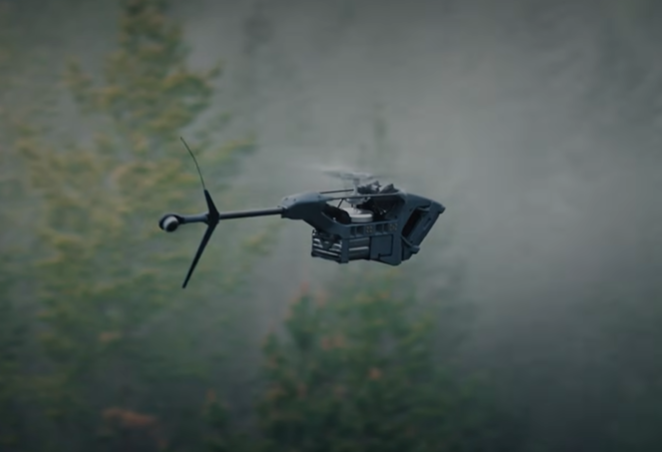
A new reconnaissance system (Black Recon) has been designed to address those challenges by combining autonomous drones with automated launch, recovery, and recharging capabilities. Instead of treating drones as standalone aircraft, the system operates them as part of a self-sustaining reconnaissance network capable of maintaining near-continuous coverage.
According to Interesting Engineering, at the center of the concept is a docking station mounted on a vehicle or fixed installation. The station houses up to three micro-drones, each weighing less than 450 grams. When one aircraft completes its mission and returns for recharging, another can launch automatically, allowing surveillance operations to continue with minimal interruption.
The drones are designed to perform intelligence, surveillance, reconnaissance, and target acquisition missions beyond the line of sight of the protected platform. Once airborne, they can remain in the air for approximately 50 to 60 minutes and reach speeds of up to 25 meters per second.
A key feature is the ability to operate in GPS-denied environments. Rather than depending exclusively on satellite navigation, the drones use visual-inertial navigation systems and onboard sensors to determine their position and continue missions when GPS signals become unavailable or unreliable. This capability also supports radio-silent operations, reducing dependence on continuous communications links.
The system can carry both visible-spectrum and thermal imaging payloads, providing real-time imagery under a range of operational conditions. It can also function as a communications relay, extending connectivity for forces operating in challenging terrain or complex urban environments.
From a defense perspective, autonomous reconnaissance systems are increasingly important because they allow troops to maintain situational awareness while remaining under armor or behind cover. Reducing the need for personnel to leave protected positions can improve survivability while accelerating access to intelligence.
The modular architecture also leaves room for future expansion. Planned payloads include chemical, biological, radiological, and nuclear sensors, along with other mission-specific capabilities. As militaries seek persistent surveillance solutions that can survive electronic warfare environments, systems that combine autonomy, resilience, and continuous operation are becoming a growing area of focus.























