

This post is also available in:
 עברית (Hebrew)
Modern militaries face a growing challenge in striking high-value targets that are both well-defended and highly mobile. Traditional cruise and ballistic missiles offer range and payload, but their predictable trajectories and longer flight times give adversaries opportunities to detect, track, and respond. As air defenses improve, the window for engaging time-sensitive targets continues to narrow.
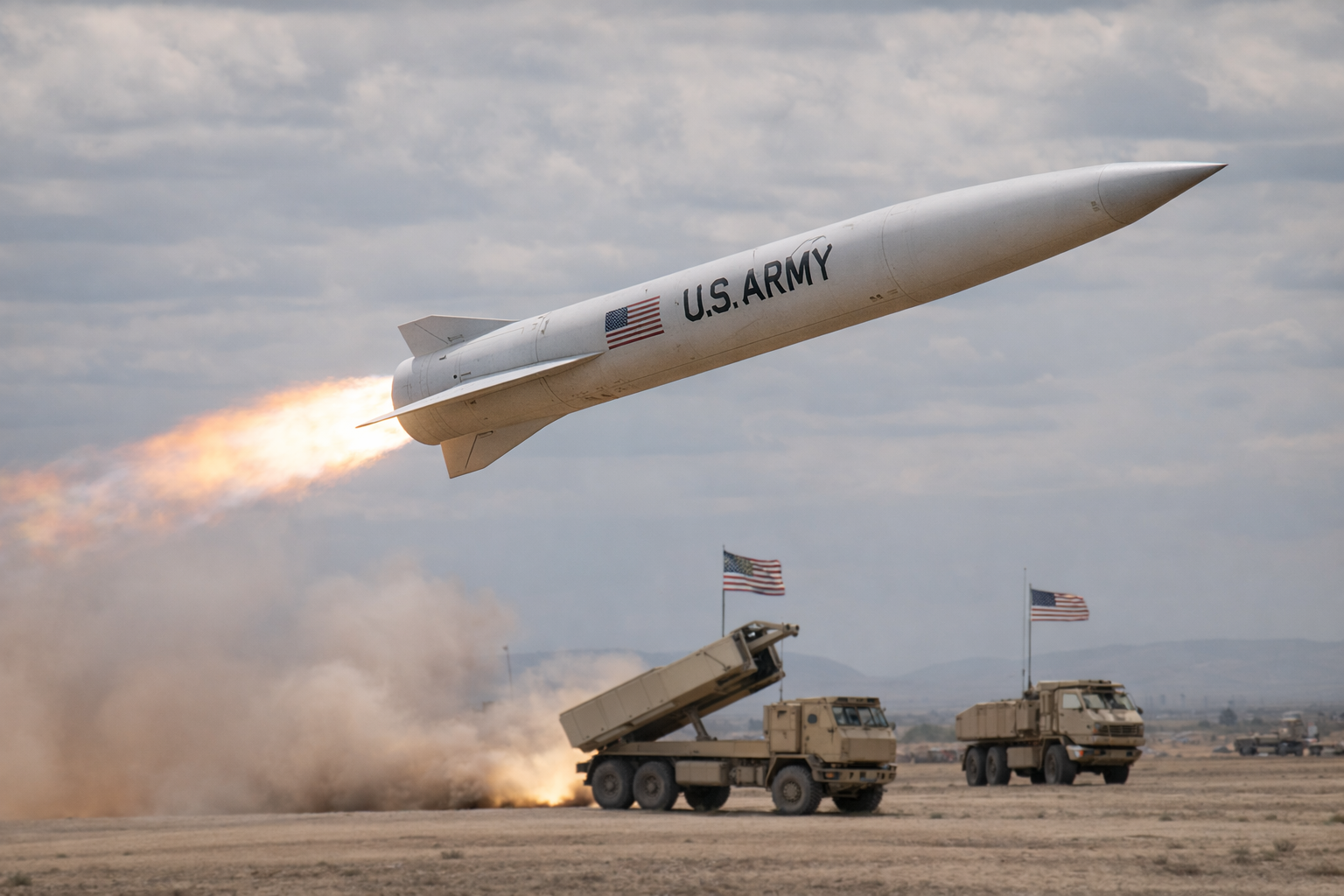
The U.S. Army’s Long Range Hypersonic Weapon, known as Dark Eagle, is designed to address that gap. New details disclosed during a recent briefing at Redstone Arsenal indicate the system has a significantly longer reach than previously acknowledged. U.S. Army officials now describe the weapon as capable of striking targets at distances of around 3,500 kilometers, placing it among the longest-range ground-based conventional strike weapons in service.
The weapon is a trailer-launched, boost-glide missile. After launch, a rocket booster accelerates the payload to hypersonic speeds before releasing a glide vehicle that maneuvers through the atmosphere toward its target, following a flight profile intended to complicate detection and interception.
The system’s value lies in its combination of speed, range, and maneuverability. U.S. Army officials stated that the weapon could traverse its maximum range in under 20 minutes, significantly reducing warning time for an adversary. This makes it particularly suited for prompt strikes against critical assets such as air-defense nodes, radar sites, or command-and-control facilities, which may relocate or shut down quickly when threatened.
According to Interesting Engineering, briefings also offered insight into the weapon’s payload. The warhead is described as weighing less than 13.5 kgs, far smaller than those carried by traditional long-range missiles. Its effectiveness relies largely on kinetic energy generated by extreme velocity, supplemented by a payload designed to disperse fragments over an area comparable to a large parking lot. This configuration is intended to neutralize “soft” but vital targets rather than hardened structures.
The weapon is expected to become the first hypersonic weapon fielded for frontline U.S. Army units. A related version, using the same missile architecture, is being developed for naval deployment from surface ships and submarines. Together, these systems reflect a broader shift toward conventional prompt-strike capabilities built to operate inside heavily defended environments, where speed and unpredictability are increasingly decisive.























