

This post is also available in:
 עברית (Hebrew)
Modern armored vehicles have become increasingly difficult to defeat as active protection systems, reactive armor, and rapid maneuvering continue to advance. Conventional anti-tank weapons often require operators to get dangerously close, and slower drones risk interception by short-range air defenses. This has driven demand for loitering munitions that can wait out a target, approach from unexpected angles, and strike at vulnerable points with minimal operator exposure.
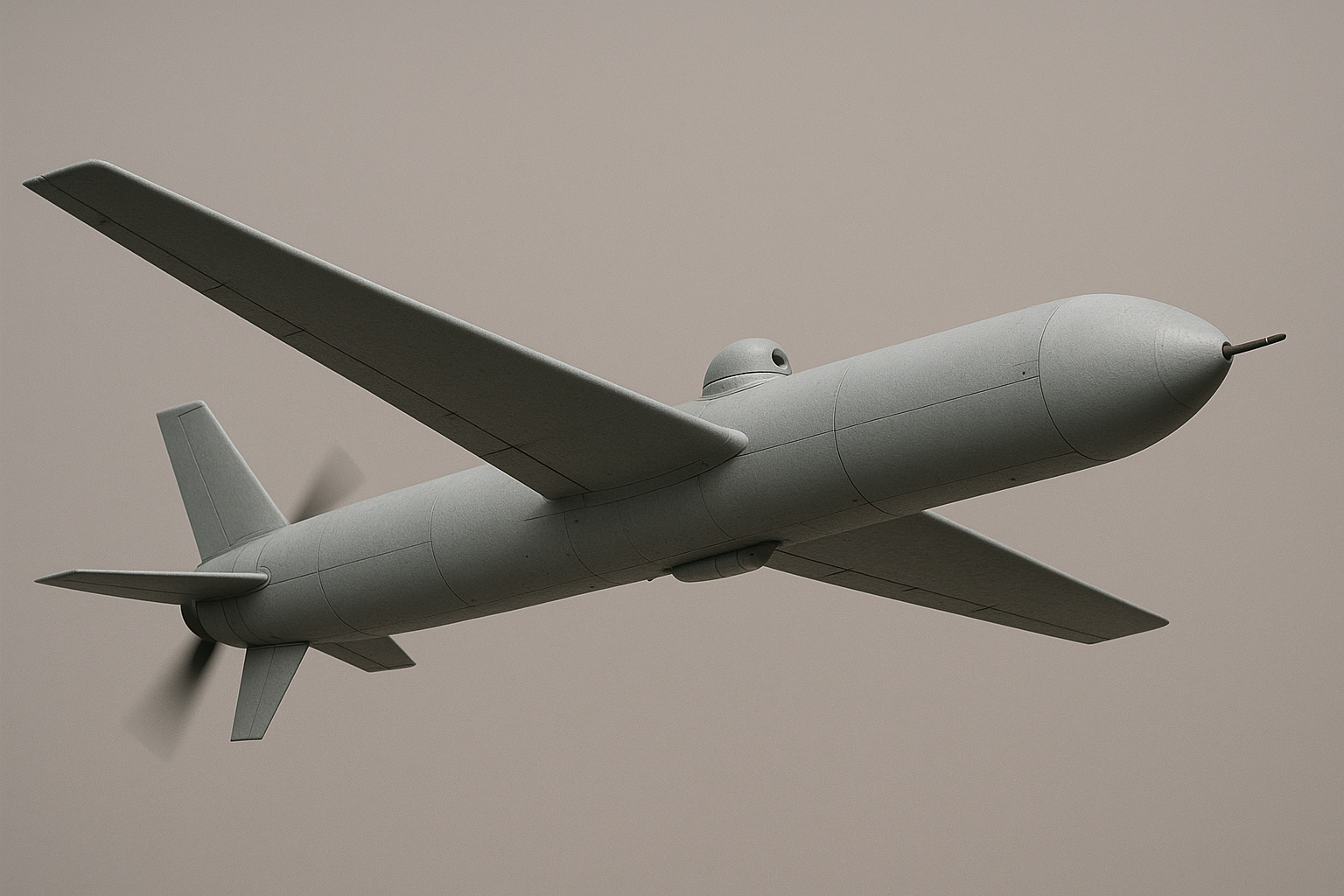
A newly unveiled system, the Gavran 145, is designed with these challenges in mind. The platform is a compact, long-range loitering munition intended for deep-strike missions against armored or fortified targets. Measuring just over two meters in length, it can be transported and launched with relatively little logistical effort. Once airborne, the munition can loiter for up to three hours—enough time to observe a target area, track movement, and execute an attack only when conditions favor a successful hit.
The combination of endurance, speed, and autonomous terminal guidance is particularly relevant. The system’s top-attack capability, with selectable dive angles between 15 and 75 degrees, is engineered to defeat armor from above—traditionally the weakest part of a vehicle. Its guidance suite blends GPS, GNSS, and inertial navigation, allowing the munition to maintain accuracy even if external signals are disrupted. In its turbo-jet configuration, it can accelerate to high subsonic speeds, reducing the target’s ability to evade or deploy countermeasures.
According to NextGenDefense, the system’s modularity extends to its payload. Operators can choose from several warhead types, including anti-armor, blast-fragmentation, and heavier options designed to penetrate explosive reactive armor. A 15-kilogram payload capacity balances impact with the need to keep the overall design small and maneuverable. The system can also support real-time ISR and area-denial missions, expanding its utility beyond direct attack roles.
Launch is achieved using a solid-propellant booster, after which the wings deploy and the drone transitions to its selected propulsion system—electric, gasoline, or turbo-jet—depending on mission needs. The munition’s operational range of roughly 120–150 kilometers positions it as a cost-effective tool for long-distance precision engagements or coordinated multi-munition strikes using ripple-fire techniques.
As the design continues to mature, the system joins a growing class of long-range loitering munitions built to combine extended endurance, flexible propulsion options, and multiple attack profiles in a single platform.























