

This post is also available in:
 עברית (Hebrew)
Robots are increasingly being used for inspections, emergency response, and field operations in locations that are difficult or dangerous for people to reach. However, conventional wheeled robots often struggle with steep slopes, rocks, stairs, and uneven terrain, while legged robots typically sacrifice speed and endurance. Bridging the gap between the two has become a major focus of robotics development.
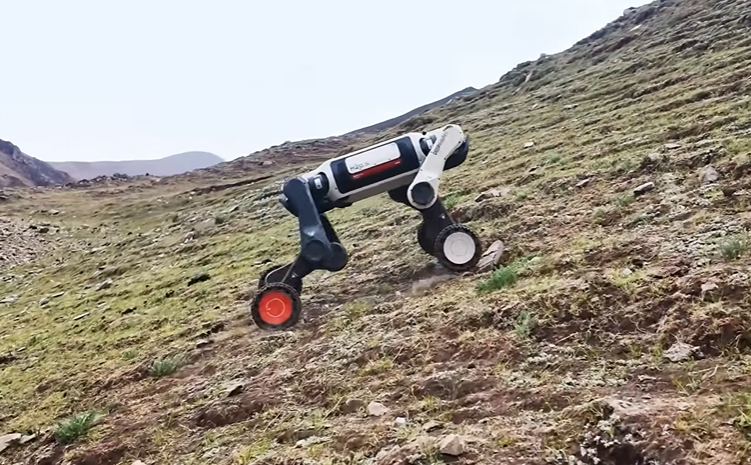
A newly demonstrated wheeled-legged robot (called Lynx M20S by DEEP) aims to combine the advantages of both mobility systems in a single platform capable of operating across challenging outdoor environments.
During recent demonstrations, the robot traversed rocky mountain trails, crossed icy rivers up to 80 centimeters deep, climbed slopes reaching 45 degrees, and continued operating in temperatures as low as -30°C. The trials were designed to showcase its ability to maintain mobility in conditions that would challenge many conventional robotic platforms.
The system combines wheels for efficient movement on relatively smooth terrain with articulated legs that allow it to climb obstacles, negotiate uneven ground, and maintain stability when conditions become more demanding. This hybrid approach enables faster travel than fully legged robots while preserving much of their terrain adaptability.
Weighing approximately 35 kilograms, the robot can carry payloads of up to 15 kilograms during normal operations and supports a maximum load of 50 kilograms. It is also capable of climbing stairs, overcoming obstacles up to 80 centimeters high, and maneuvering through confined spaces with limited clearance.
According to Interesting Engineering, navigation relies on an extensive perception suite. Dual 96-line LiDAR sensors provide wide-area three-dimensional mapping, while onboard cameras and obstacle-avoidance systems continuously monitor the surrounding environment. Together, these sensors allow the robot to navigate autonomously across rugged landscapes while avoiding obstacles.
To support extended missions, the platform incorporates dual hot-swappable batteries that increase operational endurance without requiring lengthy interruptions for recharging. Depending on payload, the robot can operate for several hours or travel distances of up to approximately 15 kilometers on a single charge.
From a defense and security perspective, highly mobile ground robots capable of traversing difficult terrain could support reconnaissance, infrastructure inspection, logistics, search-and-rescue operations, and hazardous-environment missions. Their ability to reach areas inaccessible to larger vehicles may reduce risk to personnel while expanding operational reach.
As autonomous ground systems continue to evolve, hybrid wheeled-legged platforms are emerging as a practical solution for environments where neither wheels nor legs alone provide sufficient mobility.























