This post is also available in:
 עברית (Hebrew)
Operating aircraft over heavily defended territory has become increasingly difficult as air-defense systems grow more capable and networked. Traditional surveillance platforms struggle to remain undetected long enough to collect and relay useful intelligence, particularly at long range and high altitude. This has driven interest in unmanned aircraft designed from the outset for low observability and sustained operations in contested airspace.
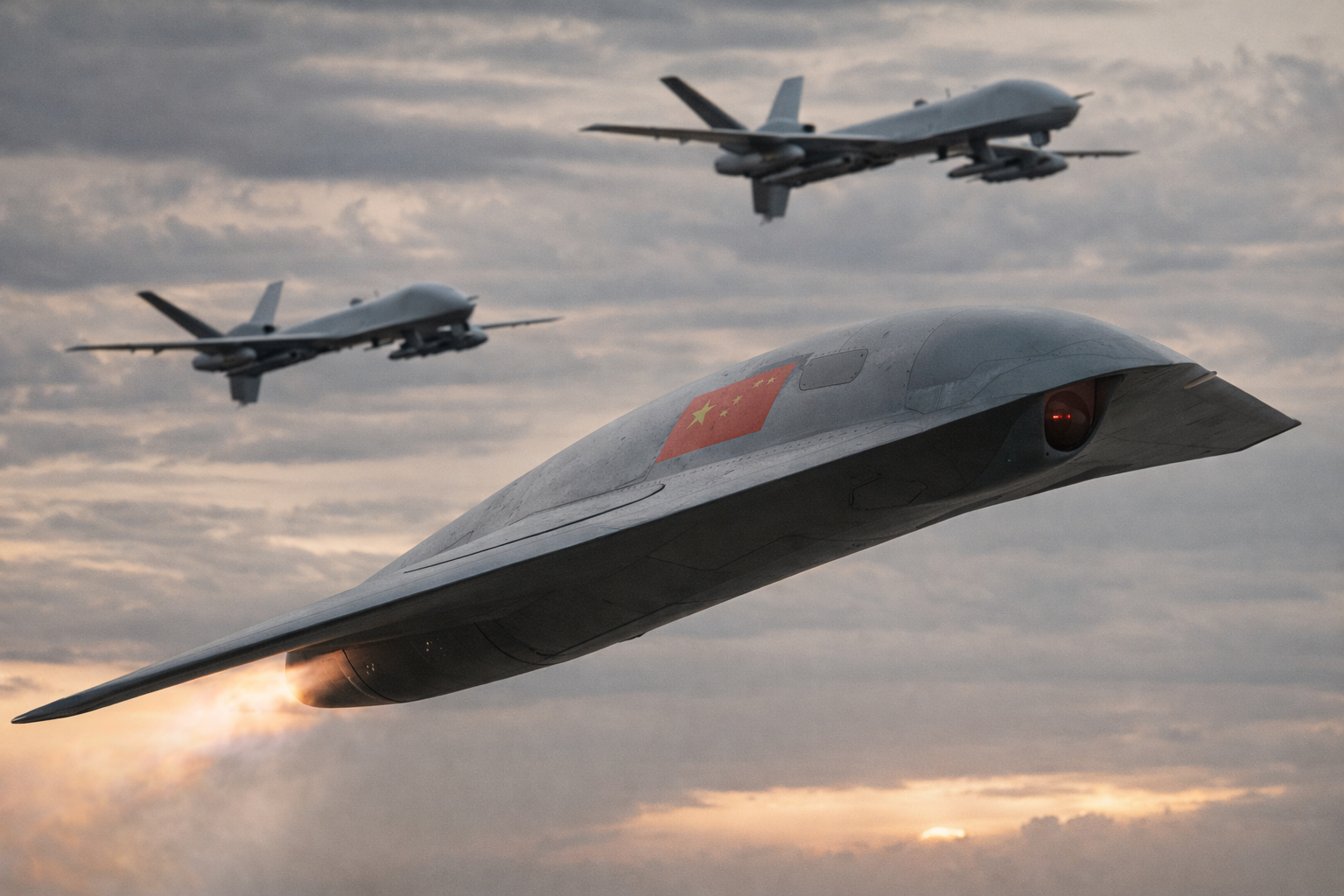
A new stealth reconnaissance drone has now taken a key step toward that role by completing its maiden flight. The aircraft, known as the CH-7, recently conducted its first test sortie at an airfield in northwest China, according to state media. The initial flight marked the transition from ground development to airborne testing and focused on validating basic aerodynamic behavior and flight-control performance rather than mission systems.
During the sortie, the drone demonstrated autonomous taxiing, takeoff, landing, attitude control, and trajectory tracking. Developers said the data collected closely matched pre-flight simulations, an important benchmark for an aircraft with a complex aerodynamic layout. The aircraft uses a tailless, high-aspect-ratio flying-wing configuration, which supports endurance and stealth but also presents challenges in stability and control during early testing.
Platforms of this type are intended to provide persistent intelligence, surveillance, and reconnaissance without relying on forward-based manned aircraft. A stealthy, high-altitude UAV can operate ahead of other forces, monitor large areas, and relay targeting or situational data while reducing exposure to air defenses. Such capabilities are especially relevant for long-range maritime monitoring and operations in contested regions.
According to Interesting Engineering, the aircraft’s design emphasizes low observability. Public displays of the airframe show a smooth flying-wing shape with no vertical tail, an engine intake mounted on the upper fuselage, and a partially concealed exhaust. Reports also point to radar-absorbing structures in high-reflection areas, surface coatings intended to reduce radar returns, and treatments applied to access panels, landing-gear bays, and even fasteners to limit detectability. The internal payload space is designed to carry visible-light and infrared sensors while preserving a clean external profile.
Future test phases are expected to expand into performance evaluations and verification of onboard mission payloads. Demonstration materials shown previously depict the drone conducting long-duration patrols and transmitting collected data to command elements, potentially supporting long-range strike operations through information sharing.
Analysts cited in Chinese reports describe the aircraft as optimized for persistence and survivability rather than close-in combat roles. In that sense, it aligns more closely with large, high-value stealth reconnaissance aircraft than with smaller “loyal wingman” concepts, positioning it as a forward sensor platform operating ahead of other assets rather than alongside them.