
This post is also available in:
 עברית (Hebrew)
Making a small robot move quickly across unpredictable terrain presents a basic engineering problem. Tiny machines cannot carry large motors or heavy power systems, while rigid legs can struggle on soft, uneven surfaces such as grass and sand. Researchers have now demonstrated another approach: let the robot slowly store energy in flexible rods, then release it all at once.
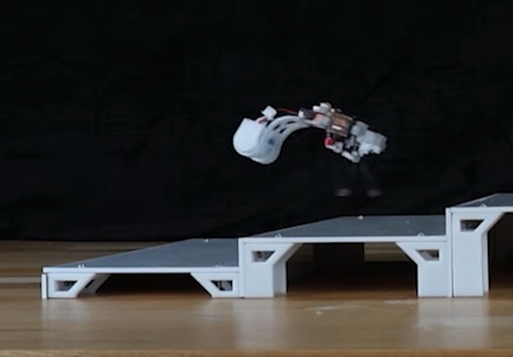
Researchers at UCLA and the University of Michigan have developed elastic snap actuators that turn relatively small motor movements into sudden bursts of mechanical power. They demonstrated the technology on a frog-like robot capable of hopping across six different surfaces, climbing steps, performing backflips and even swimming.
The mechanism relies on elastic rods that are bent, twisted and compressed simultaneously. As a motor gradually deforms a rod, elastic energy accumulates inside it. Once the structure reaches a critical configuration, it rapidly snaps into another shape and releases that energy.
According to TechXplore, the principle is similar to slowly compressing a spring before suddenly letting it go. The motor does not need to provide the robot’s full propulsion force directly; it only needs enough power to gradually load the elastic structure.
Geometry determines how that energy is released. Using computational models and physical experiments, the researchers studied which rod configurations deform smoothly and which produce the rapid snapping motion needed for propulsion.
They then incorporated helically shaped rods into an 11-centimeter-long robot weighing just 98.2 grams. A rotating motor repeatedly winds each actuator until it snaps, pushing the machine forward.
The results were particularly noticeable on difficult terrain. The robot traveled across wood, cloth, acrylic, leather, grass and sand, moving faster than a comparable rigid-legged design on every surface tested. It averaged 2.46 body lengths per second across the six terrains, compared with 0.79 for the rigid-legged robot.
On wood, it reached a peak speed of 3.21 body lengths per second. The difference was especially pronounced on cloth and grass, where the rigid version almost stopped moving.
The same mechanism produced other forms of locomotion. The robot could repeatedly launch itself into backflips, while adding thin flexible fins allowed it to swim at approximately 0.5 body lengths per second, turn and navigate around obstacles.
Researchers also teleoperated the machine through a sandbox containing rocks and demonstrated autonomous steering using light sensors.
For defense, emergency response and security applications, this type of locomotion could eventually help miniature robots cross rubble, vegetation or confined spaces where wheels and rigid legs struggle. Small machines could scout hazardous areas while keeping personnel farther from danger.
The broader advantage lies in shifting some of the work from electronics to mechanics. Instead of installing a larger motor to produce every powerful movement directly, the robot lets its structure accumulate energy slowly and release it quickly, giving a lightweight machine considerably more movement than its motor could provide on its own.
The research was published here.