
This post is also available in:
 עברית (Hebrew)
Autonomous drones can move quickly in open air, but cluttered environments are much harder. Buildings, trees, narrow passages and other obstacles leave little room for error, and many navigation systems respond by creating conservative safety zones that force the aircraft to slow sharply whenever space becomes tight.
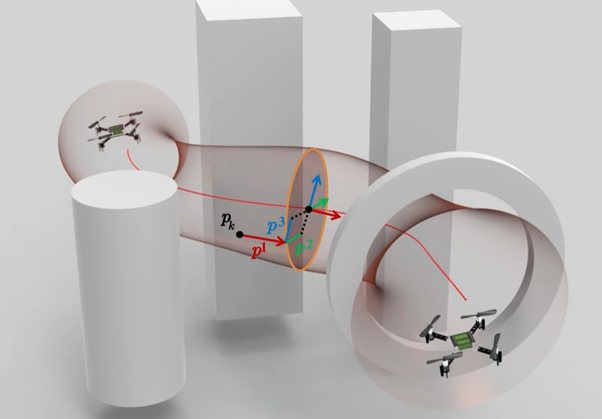
Researchers at Durham University have developed a navigation system called CORTO-Planner that takes a less restrictive approach. Instead of surrounding obstacles with rigid boundaries, the system creates flexible safe corridors that give the drone more room to maneuver while still maintaining clearance from its surroundings.
The technique uses what the researchers call a piecewise parametric safe corridor. In simple terms, the software divides the available flight space into connected sections whose shape can adapt to the geometry of the environment.
That matters because existing approaches often involve a tradeoff. A corridor that closely follows a complicated environment can produce abrupt changes in the planned trajectory, resulting in jerky flight. A smoother representation can be easier for the drone to follow but may exclude large areas that are actually safe to use.
The system is designed to provide both.
According to TechXplore, its corridors can offer up to six times more usable space than previous methods and provide as much as 59% greater clearance around obstacles. The additional room allows the planning software to choose smoother trajectories without unnecessarily reducing speed.
The team also developed a more efficient way to perform the underlying calculations, allowing the system to replan in real time rather than depending on computationally intensive optimization that takes too long for fast-moving aircraft.
Researchers tested it in simulation and aboard physical drones navigating courses containing narrow openings, sharp turns and maze-like layouts. Across multiple environments, the system produced faster flight times and higher average speeds than several existing planning methods while continuing to avoid obstacles.
Smoother trajectories can bring another benefit: efficiency. Frequent acceleration, braking and abrupt direction changes consume energy and place additional stress on motors and other components. Reducing those unnecessary movements could therefore extend operating time and reduce mechanical wear.
The technology could be useful for search and rescue, infrastructure inspection, warehouses and environmental monitoring, where autonomous aircraft may need to move rapidly through confined spaces.
There are also clear defense and public-safety applications. Small drones operating inside damaged buildings, forests or dense urban areas could perform reconnaissance or search missions where direct human piloting is difficult and collisions could end the mission.
The researchers have released the software openly and say the underlying approach could eventually extend beyond aerial drones to autonomous vehicles, robotic arms and underwater robots.
The key change is relatively simple: instead of finding one narrow safe path and forcing the drone to follow it, give the aircraft a larger, smoother corridor in which it can decide how best to move.
The research was published here.