

This post is also available in:
 עברית (Hebrew)
Keeping frontline units supplied has always been one of the most dangerous tasks in military operations. Vehicles carrying ammunition, equipment, and spare parts often travel through areas exposed to enemy fire, placing logistics personnel at significant risk. As autonomous technology matures, militaries are increasingly exploring ways to shift some of those missions from human drivers to robotic platforms.
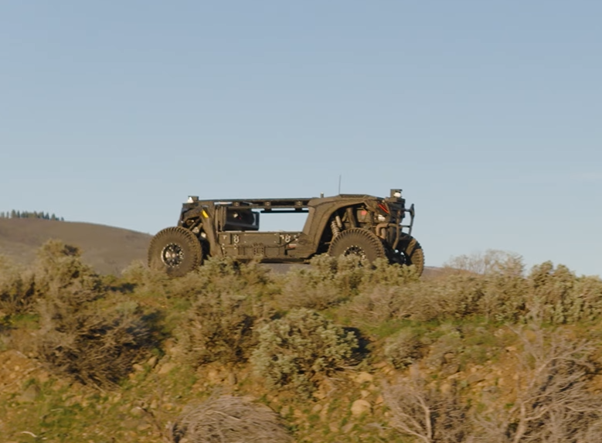
A new production program (by Overland AI) marks a significant step in that direction. More than a dozen autonomous ground vehicles are set to enter US military service under a production contract supporting frontline air defense operations.
Unlike many existing unmanned ground vehicles that still depend heavily on remote operators, these platforms are designed to navigate independently. Operators simply assign a destination, after which the onboard autonomy system analyzes the surrounding terrain, selects a route, and controls the vehicle with minimal human intervention. If necessary, personnel can still assume remote control at any point during the mission.
The vehicles will initially support logistics operations for a mobile air defense system, transporting supplies and equipment to frontline units. Automating these resupply missions reduces the need for personnel to enter high-risk areas while allowing combat units to remain supplied during operations.
According to Interesting Engineering, at the core of the platform is an autonomous navigation system capable of interpreting terrain and making driving decisions in real time. Rather than following pre-programmed routes alone, the software continuously evaluates the environment and adapts to changing conditions, allowing the vehicle to operate across varied landscapes without constant operator input.
Another notable feature is its open architecture. The autonomy software is designed to integrate with existing military vehicle platforms, allowing defense organizations to incorporate autonomous driving capabilities without replacing entire vehicle fleets.
From a defense perspective, autonomous logistics is becoming an increasingly important element of future military operations. Recent conflicts have demonstrated the vulnerability of supply convoys, while the growing use of drones and precision weapons has increased the risks associated with moving personnel and equipment close to the front line. Robotic resupply vehicles offer one way to reduce those risks while maintaining operational tempo.
Although logistics will be the platform’s initial role, the underlying technology is suitable for a broader range of missions. Autonomous ground vehicles could eventually support reconnaissance, intelligence collection, engineering tasks, breaching operations, and other missions where reducing personnel exposure is a priority.
As autonomous ground systems transition from experimentation to production, they are becoming an increasingly practical component of modern battlefield operations rather than simply a technology demonstration.























