

This post is also available in:
 עברית (Hebrew)
Drones have become valuable tools for inspection, emergency response, industrial monitoring, and aerial reconnaissance. Yet even advanced platforms often struggle in confined environments filled with obstacles. Passing through narrow gaps, navigating collapsed structures, or maneuvering inside complex industrial facilities requires a level of agility that many autonomous systems still lack.
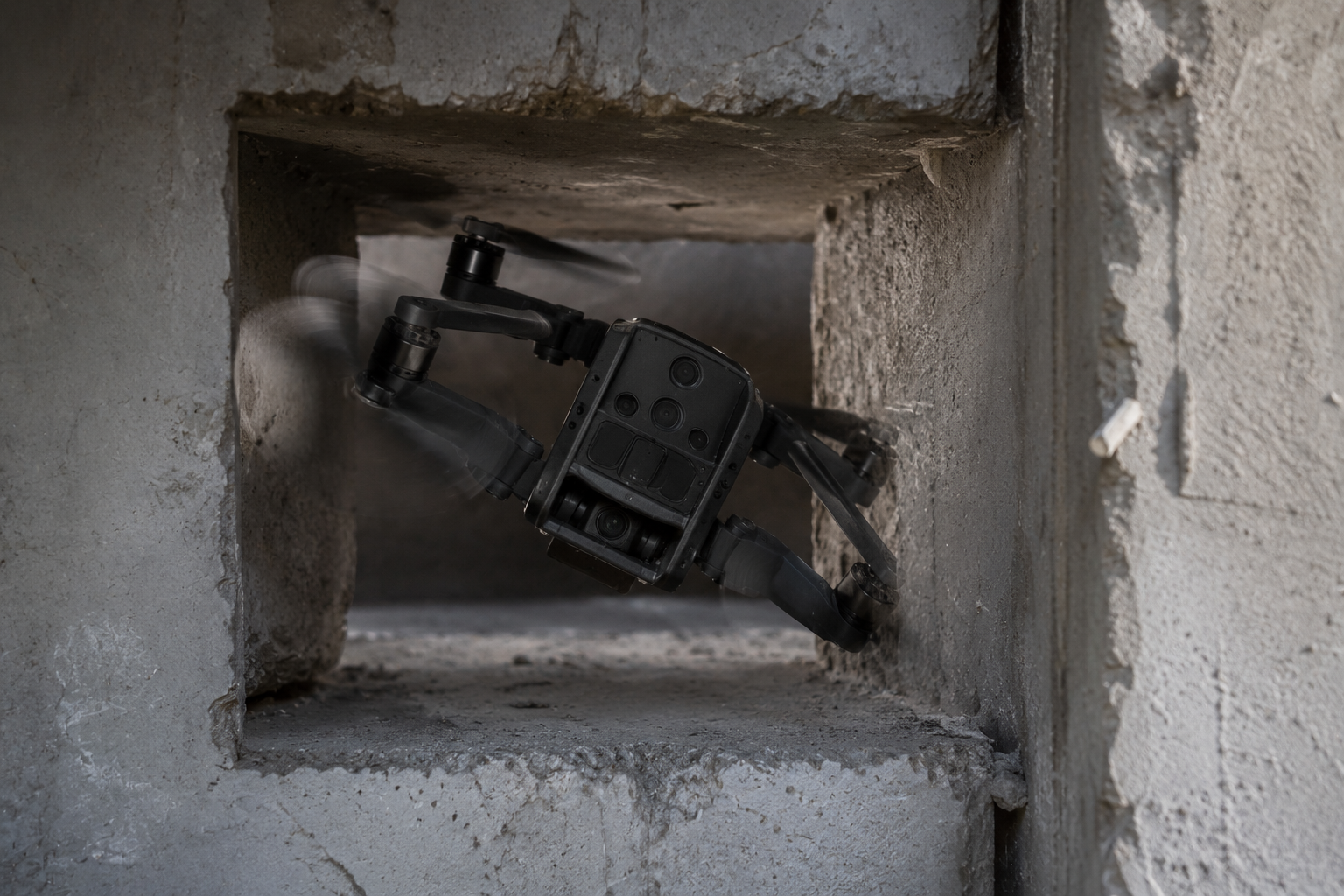
Researchers have now developed a control approach that allows drones to perform precisely those types of maneuvers. Using artificial intelligence trained through reinforcement learning, the system enables quadcopters to squeeze through extremely narrow openings while relying only on onboard sensors.
The challenge is more difficult than it might appear. To pass through a gap only slightly larger than its frame, a drone cannot simply fly straight ahead. It must rapidly adjust its orientation, tilt its body at the correct angle, and precisely coordinate motor outputs while continuously adapting to its surroundings.
According to TechXplore, the newly developed system addresses this problem through sensorimotor policies that directly convert sensor inputs into flight commands. Images from onboard cameras are combined with measurements such as orientation, angular velocity, and acceleration. The AI then translates that information into low-level motor instructions in real time.
The policies were trained using reinforcement learning, a machine-learning technique in which the system learns through repeated trial and error. During training, the drone was rewarded for successfully navigating obstacles and passing through openings while maintaining stable flight.
Testing showed that the approach allowed drones to pass through rectangular and irregular openings positioned at different angles. In some demonstrations, the aircraft successfully traversed gaps tilted by as much as 90 degrees. The drones were also able to navigate moving openings and sequences of multiple closely spaced gaps without prior knowledge of their exact location.
One particularly notable result involved navigating through an opening with only five centimeters of clearance. The drone accomplished the maneuver using onboard sensing and autonomous control rather than relying on external tracking systems.
From a defense and security perspective, highly agile autonomous navigation could be valuable for reconnaissance, search operations, infrastructure inspection, and operations in GPS-denied environments. Drones capable of maneuvering through damaged buildings, tunnels, confined urban spaces, or other difficult terrain could reach locations that are inaccessible to larger unmanned systems.
While the technology remains a research effort, it demonstrates how AI-driven flight control may allow future drones to operate in environments that currently remain beyond the reach of autonomous aircraft.
The research was published here.























