

This post is also available in:
 עברית (Hebrew)
Robots are often limited by how they move. Wheels struggle with obstacles, legs require complex joints and control, and propellers add weight and energy demand. Each environment—land, water, confined spaces—usually requires a different mechanical design. That fragmentation makes robots harder to deploy in unpredictable or mixed terrain, where switching platforms is not an option.
A research effort is exploring a far simpler way to solve that problem by relying on a single physical effect rather than multiple locomotion systems. The approach uses an off-center spinning mass inside the robot to generate motion through centripetal force. When the mass spins, it creates forces that can push, lift, or rotate the robot’s body, depending on how the system is tuned. The principle is familiar from everyday life: an unbalanced washing machine vibrating during a spin cycle.
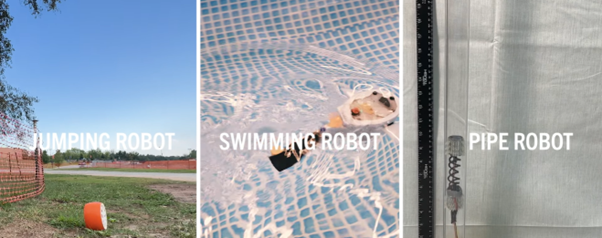
Using this effect, researchers have demonstrated several very different robots powered by essentially the same mechanism. One prototype resembles a simple wheel, yet it can roll across flat ground and then jump repeatedly by accelerating its internal mass. Unlike spring-driven jumpers, it does not need time to reset, making it well-suited for rough or uneven surfaces.
According to Interesting Engineering, the same idea has been adapted for water. A fish-like robot transfers energy from the spinning mass into a flexible tail, allowing it to swim, turn, and dive by changing rotation speed. Because the motion relies on internal dynamics rather than external propellers, the system is relatively energy efficient and mechanically simple. Another version is designed for confined spaces: inside narrow pipes, a rotating mass causes small bristles to grip and release against the walls, producing forward motion even in passages just a few centimeters wide.
The concept is now being extended into the air. Researchers are investigating whether spinning masses can drive wings at the very high frequencies needed for insect-like flight, potentially replacing conventional motors in small flying robots.
From a defense and homeland security perspective, this type of locomotion is particularly relevant. Robots that can roll, jump, swim, crawl through pipes, and potentially fly—without changing platforms—are well-suited for search and inspection in complex environments. Applications could include tunnel reconnaissance, infrastructure inspection, maritime monitoring, or operations in collapsed structures where access is limited and terrain changes rapidly.
By reducing locomotion to a controllable physical effect rather than complex mechanical assemblies, spinning-mass robots point toward a new class of adaptable systems—machines that move not by adding parts, but by exploiting physics more efficiently.























