This post is also available in:
 עברית (Hebrew)
Entering a burning structure remains one of the most dangerous tasks for emergency responders. Extreme heat, toxic smoke, and unstable interiors often prevent crews from gaining a clear picture of what is happening inside until they physically cross the threshold. Conventional drones offer some help, but most fail quickly once temperatures rise, leaving a critical information gap during the earliest and riskiest stages of an incident.
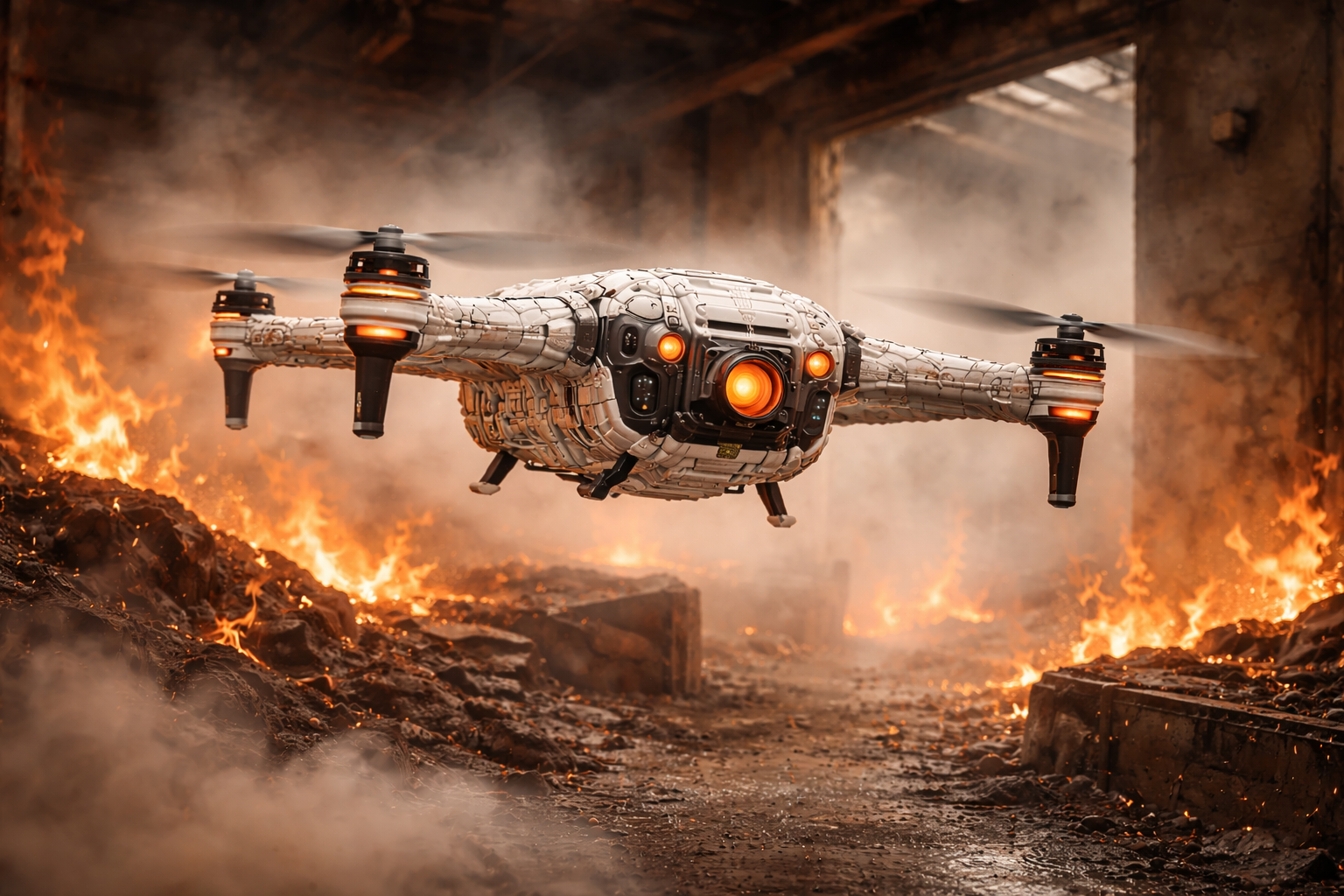
A newly redesigned firefighting drone aims to close that gap by operating where others cannot. The FireDrone (by Empa) has been reengineered to survive temperatures of up to 200°C, allowing it to fly inside active fires rather than around their edges. The key to this capability lies in a new protective shell made from high-temperature polyimide aerogel that shields onboard electronics from heat damage.
Instead of relying on multiple insulation layers, the drone uses a single, cast aerogel structure that fully encases sensitive components. Aerogels are mostly air trapped in a porous solid, giving them exceptional thermal insulation with very low weight. Casting the material into a one-piece shell simplifies the internal design while improving durability and maintaining maneuverability. Combined with active cooling and continuous temperature monitoring inside the drone, this hybrid approach allows sustained operation in environments that would quickly disable standard platforms.
According to Interesting Engineering, the drone is equipped with an infrared camera that streams live thermal imagery to operators outside the danger zone. This gives incident commanders early situational awareness, helping them identify hotspots, structural risks, or possible locations of trapped individuals before sending crews inside. The platform can also carry additional sensors, such as gas detectors or external temperature probes, depending on the mission.
Because fires often occur indoors or underground, the drone is designed to operate without satellite navigation. Its control and localization systems are optimized for use in buildings, tunnels, and industrial facilities where GPS is unavailable. This makes it suitable for complex interiors such as warehouses, factories, or power plants.
From a defense and homeland security perspective, the technology has broader relevance; fire-resistant drones capable of operating in extreme heat could support responses to industrial accidents, attacks on critical infrastructure, or incidents involving hazardous materials. They may also assist in inspections of high-temperature facilities where human access is limited, reducing risk while maintaining operational continuity.
With repeated testing already completed in training grounds and industrial sites, this drone is moving closer to practical deployment. By combining advanced insulation with real-time sensing and indoor navigation, it represents a step toward unmanned systems that can safely enter environments still too dangerous for people.