This post is also available in:
 עברית (Hebrew)
The rapid spread of unmanned aerial systems has made airspace security more complex for military forces and critical facilities. Small drones are increasingly capable, inexpensive, and easy to deploy, while traditional counter-UAS setups often rely on isolated sensors and manual coordination. As threats become faster and more numerous, defenders face a growing challenge in identifying, prioritizing, and responding to aerial intrusions in real time.
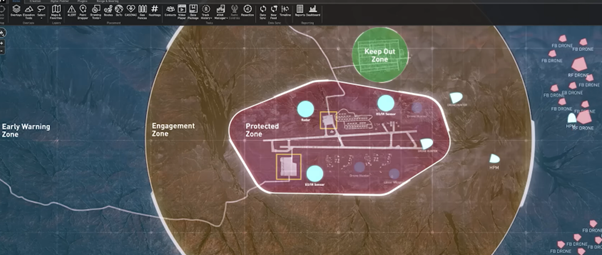
A new counter-drone platform (C-UAS) called Sanctum is designed to address that gap by shifting much of the detection and decision process into the cloud. The system brings together artificial intelligence, distributed sensing, and real-time data processing into a single architecture intended to manage complex counter-UAS missions more efficiently. Rather than treating sensors and effectors as separate tools, the system links them through a unified digital backbone that allows threats to be tracked across locations and handled as part of a coordinated response.
At the core of the system is a modular and scalable design. The system can integrate multiple types of sensors and effectors while supporting automated threat analysis and prioritization. By continuously processing incoming data, the platform is built to classify aerial objects and surface the most urgent threats without requiring constant manual input. This approach is intended to reduce operator workload and shorten the time between detection and response.
Military bases, deployed forces, and sensitive infrastructure are increasingly exposed to drone activity that can range from surveillance to direct attack. A system that can fuse data from multiple sensors, assess threats automatically, and support coordinated action across domains aligns with the need to defend wide areas against fast-moving aerial targets.
According to NextGenDefense, the system’s architecture is designed for interoperability. A built-in software development kit allows third-party sensors and effectors to be connected, giving operators flexibility as new technologies emerge. The system also supports multi-sensor tracking across geographically separated sites, enabling a broader operational picture rather than isolated point defenses.
The digital backbone relies on cloud-based processing to handle data at scale. Real-time analytics and AI tools are used to accelerate detection and tracking, while unified mission-management interfaces present only mission-critical information to users. Monitoring tools are intended to keep operators focused on priority threats rather than raw data streams.
By combining cloud connectivity with AI-driven analysis, the system reflects a shift in counter-UAS design toward software-centric systems that emphasize speed, scalability, and integration. As drone threats continue to evolve, platforms built around these principles are likely to play an increasingly central role in airspace protection.