

This post is also available in:
 עברית (Hebrew)
Security agencies continue to face a difficult tradeoff when screening for explosives and hazardous chemicals. Imaging systems such as X-ray and millimeter-wave scanners can quickly flag suspicious shapes, but they struggle to identify what a substance actually is. More precise chemical detection methods exist, yet they usually require close access to the target, slowing operations and increasing risk in crowded or sensitive environments.
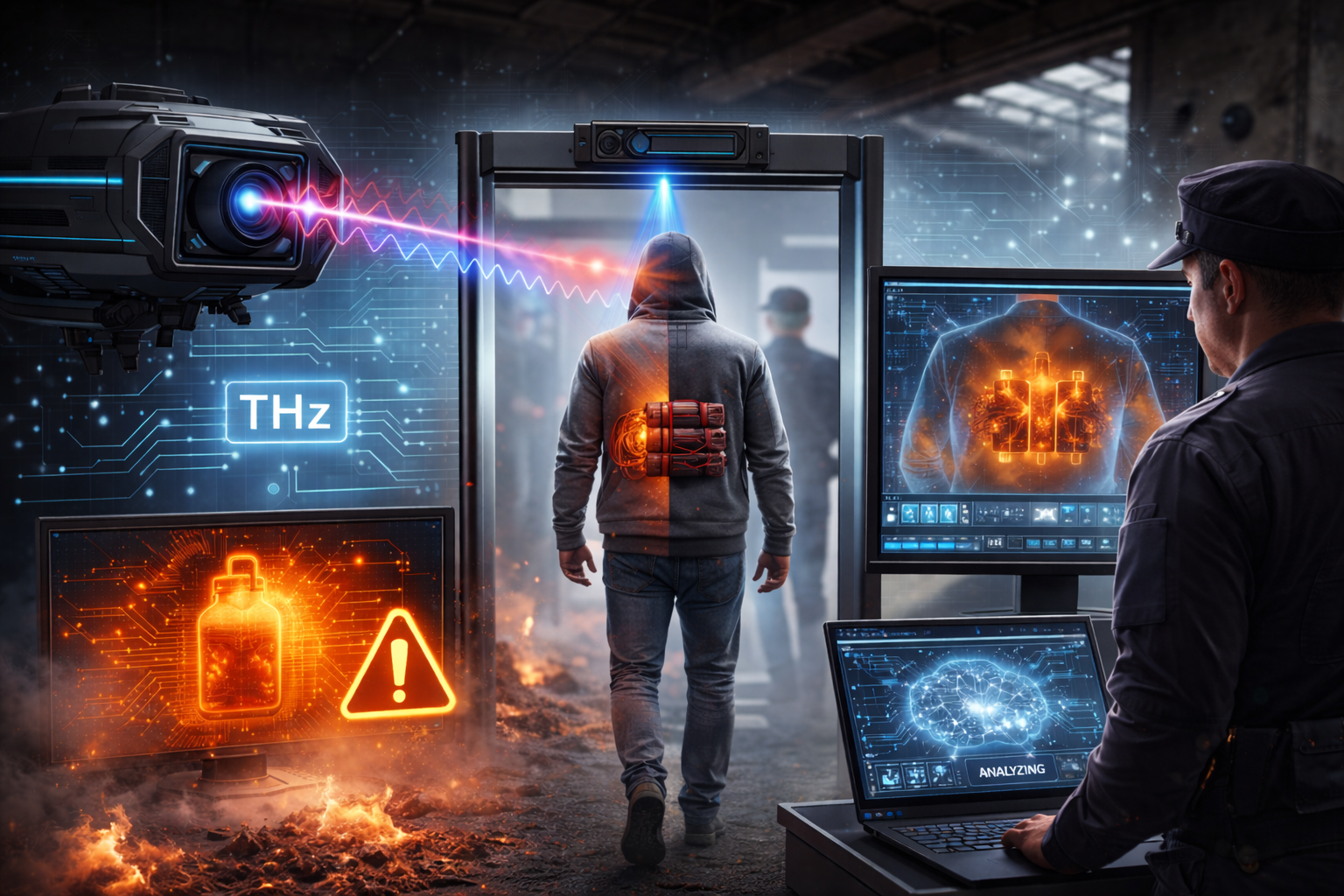
A newly demonstrated sensing approach aims to close that gap by combining terahertz imaging with artificial intelligence. Terahertz radiation occupies a unique part of the electromagnetic spectrum: it can pass through materials like clothing, paper, and plastic without ionizing radiation, while also carrying information about a material’s chemical structure. In practice, however, real-world use has been limited. Packaging materials, surface roughness, and scattering effects often distort terahertz signals, making reliable identification difficult.
According to TechXplore, the new system addresses this by rethinking how terahertz data is collected and analyzed. Instead of averaging spectra, it captures individual time-domain pulses reflected from a target. These raw signals are generated and detected using plasmonic nanoantenna arrays, which provide high bandwidth and a large dynamic range. The result is a richer dataset that preserves subtle chemical features often lost in conventional processing.
Interpreting that data is where deep learning plays a critical role. A custom architecture combining convolutional neural networks and transformer models processes each pulse, separating genuine chemical signatures from background noise and environmental artifacts. This allows the system to recognize specific substances even when their spectral fingerprints are partially obscured.
In blind tests covering eight different chemicals, including explosives such as TNT, RDX, and PETN, the system achieved pixel-level classification accuracy above 99 percent for exposed samples. More importantly for operational use, it maintained close to 89 percent accuracy when the explosives were hidden beneath opaque paper—conditions that typically defeat standard terahertz techniques.
From a defense and homeland security perspective, the implications are significant. A stand-off sensor capable of chemically identifying concealed explosives could enhance screening at checkpoints, border crossings, and public venues without physical contact. It could also support military force protection by enabling rapid inspection of suspicious packages or materials from a safe distance.
Beyond security, the same framework could be applied to pharmaceutical inspection and industrial quality control, where non-destructive chemical identification is equally valuable. By pairing terahertz physics with modern AI, the approach demonstrates how longstanding sensing limitations can be overcome, moving chemical detection closer to real-world deployment.
The research was published here.























