This post is also available in:
 עברית (Hebrew)
Detecting small, fast-moving drones is becoming increasingly difficult as unmanned aircraft operate in crowded and unpredictable airspace. Conventional detection systems rely on technologies such as radar, radio-frequency sensors, thermal imaging and optical cameras, but each has limitations. Some can be affected by electronic interference, while others require substantial computing power to process visual information quickly enough.
A new system called Hierax takes a different approach, using cameras inspired by biological eyesight to detect and track moving aerial threats.
Developed by Southwest Research Institute (SwRI), the system combines neuromorphic, or event-based, cameras with specialized software designed to identify drones in complex aerial environments.
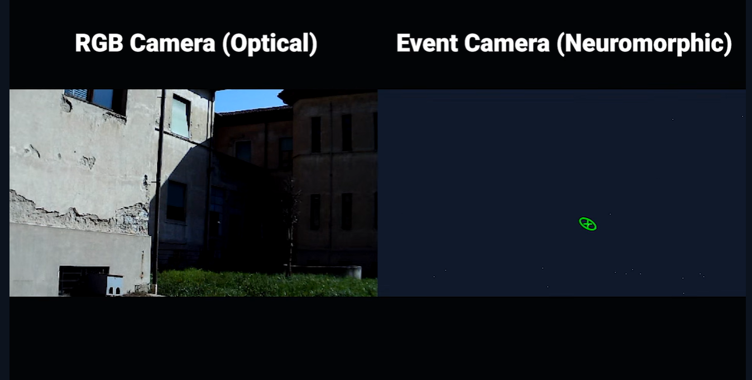
Unlike conventional cameras, which capture complete images at fixed intervals, event-based sensors respond to changes in brightness at individual pixels. Instead of continuously recording everything within their field of view, they generate information when something in the scene changes.
This allows the system to concentrate on movement, making the technology particularly suitable for detecting fast-moving objects against complicated backgrounds.
The approach also reduces the amount of visual information that needs to be processed. According to TechXplore, the system requires less computing power than conventional optical systems that depend on complex machine-learning algorithms.
Lower processing requirements, combined with the cameras’ compact size and reduced power consumption, could make the technology easier to integrate into smaller unmanned aircraft.
Another advantage is that the cameras operate passively, without transmitting signals to detect their targets. Unlike active sensing systems, they do not emit a detectable signal that an adversary could directly jam.
The system is being developed as a hardware-independent counter-drone kit that could be integrated into different unmanned aerial platforms.
The longer-term objective is to enable drones to autonomously detect, track, pursue and intercept hostile UAVs, reducing the need for continuous manual piloting during counter-drone missions.
That capability could be particularly valuable in military environments where large numbers of inexpensive drones create persistent threats to troops, vehicles and critical infrastructure.
The system uses a modular open architecture designed around U.S. Department of Defense interoperability requirements. This allows the imaging package to be integrated with different platforms and updated as new hardware becomes available, without depending on a single manufacturer.
Although neuromorphic cameras have been studied for years, adapting them to unpredictable real-world environments has remained a challenge.
It represents an effort to move that technology beyond laboratory research and into practical counter-UAS applications.
By processing changes in a scene rather than continuously analyzing full images, the system could give autonomous interceptors a faster, more efficient way to recognize moving threats, bringing machine vision closer to the way biological eyes respond to motion.