This post is also available in:
 עברית (Hebrew)
Maritime surveillance often requires both surface vessels and aerial drones to maintain awareness over large areas. While drones provide a much wider field of view than a vessel alone, they are usually limited by battery life and typically require human operators to launch and recover them. At sea, those tasks become even more challenging, particularly when vessels are moving in rough conditions.
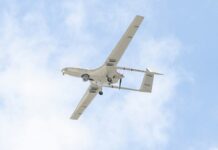
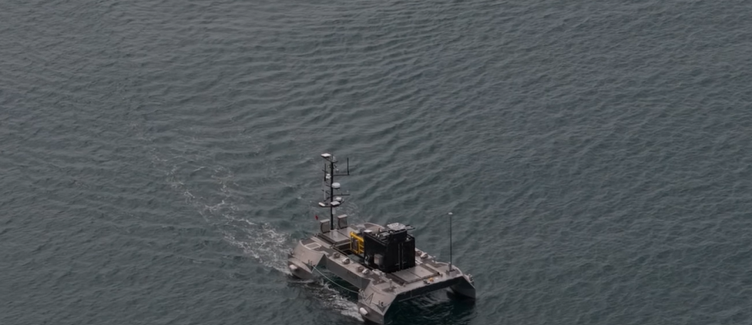
A recent demonstration by the Royal Navy explored a way to overcome these limitations by combining an unmanned surface vessel (USV) with an autonomous drone launch-and-recovery system. Developed by ACUA Ocean and Teledyne FLIR Defense, the platform allows a drone to take off, conduct surveillance and land back on a moving robotic boat without human intervention.
According to Interesting Engineering, at the center of the system is SkyCarrier, an automated launch-and-recovery module that unfolds from a protective enclosure into a stabilized landing platform. During the trials, it deployed and recovered the SkyRanger R70 drone from the deck of the company’s Pioneer unmanned surface vessel while the boat remained underway. Automating this process removes one of the biggest operational challenges of using drones from small vessels at sea.
Unlike conventional drones that rely solely on onboard batteries, the drone operated while connected to the vessel through a managed power and data tether. The tether continuously supplies electrical power, allowing the aircraft to remain airborne for much longer than battery-powered flights typically permit. It also transmits data directly to the boat while keeping the drone positioned above the vessel for persistent overhead surveillance.
The aircraft itself incorporates onboard artificial intelligence through multiple NVIDIA processors that support real-time object detection and classification. Combined with four computer-vision cameras and a stabilized electro-optical/infrared sensor payload, the drone can identify and monitor vessels, infrastructure or other objects while operating day or night.
The performance of the launch system also depends heavily on the stability of the unmanned boat. According to the company, the USV has previously demonstrated the ability to operate in waves reaching 4.25 meters, with substantially reduced rolling motion compared with conventional monohull vessels. Maintaining a stable deck is essential for reliable autonomous takeoff and landing in open-water conditions.
Although demonstrated as a maritime surveillance platform, the technology has broader defense and homeland security applications. A robotic vessel capable of continuously deploying and recovering drones could support intelligence, surveillance and reconnaissance (ISR), anti-submarine warfare, mine countermeasure operations and the protection of ports, offshore energy infrastructure and undersea communication cables. Persistent aerial coverage from an autonomous platform also reduces the need for crewed patrol vessels to remain in high-risk areas for extended periods.
The demonstration highlights a growing trend toward multi-domain autonomous systems, where unmanned vehicles operating on the sea and in the air work together as a single platform. By combining long-endurance surface operations with persistent airborne sensing, systems like this could significantly expand the reach and effectiveness of future maritime surveillance missions.