This post is also available in:
 עברית (Hebrew)
Robots designed for industrial inspection or emergency response often face a tradeoff. Wheeled platforms can move quickly and efficiently over long distances but struggle with obstacles and uneven terrain. Legged robots can navigate more complex environments, yet they tend to move more slowly and consume more energy. As industries seek robots capable of operating in hazardous locations, engineers are increasingly looking for ways to combine the strengths of both approaches.
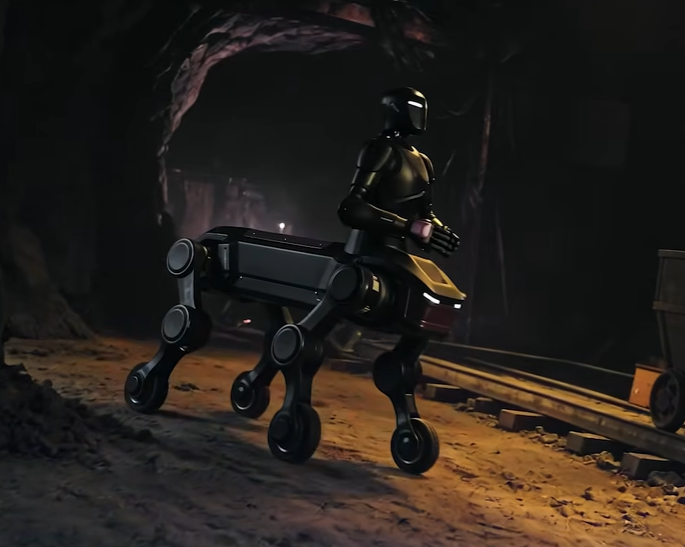
A new robotic platform from Shanghai-based Run Robotics takes that direction with what the company describes as the world’s first “centaur” wheel-leg hybrid robot. Unveiled at the 2026 World Artificial Intelligence Conference (WAIC), the system pairs a four-wheel all-terrain chassis with a humanoid upper body equipped with robotic arms, allowing it to travel rapidly while carrying out complex physical tasks.
Instead of relying on two walking legs like a humanoid robot, the lower half uses wheels to cross rough ground efficiently. According to Interesting Engineering, the upper body provides the dexterity needed for tasks that conventional inspection robots cannot perform, such as turning valves, operating equipment, removing obstacles or handling tools. This combination allows the robot to move quickly to a work site before interacting directly with its surroundings.
The platform is designed for demanding environments including industrial facilities, oilfields, mines, firefighting operations and emergency rescue missions. According to the company, it can carry a working payload of 100 to 120 kilograms while supporting a maximum static load of 210 kilograms. The upper section is modular and can be configured with different combinations of robotic arms, dexterous hands and force sensors depending on the mission.
Navigation is handled by an onboard perception system that combines LiDAR, binocular cameras and depth sensors. Together, these sensors allow the robot to build a three-dimensional model of its surroundings, recognize infrastructure such as pipelines, valves and gauges, detect obstacles and people, and automatically plan safe routes while avoiding collisions. The company says the perception system creates a continuous workflow from environmental sensing to autonomous decision-making and task execution.
Although developed primarily for civilian industries, the same capabilities are also relevant to defense and homeland security. A robot that can move rapidly across damaged infrastructure, carry heavy equipment and manipulate objects without exposing personnel to danger could support explosive ordnance disposal, military engineering, logistics, reconnaissance and disaster response. Its ability to inspect hazardous areas while operating tools could also prove valuable during chemical, biological or industrial emergencies.
The unveiling reflects a broader trend toward multifunctional mobile robots that combine autonomous navigation with practical manipulation capabilities. Rather than specializing in either mobility or dexterity, platforms such as this aim to perform both, enabling a single robotic system to travel across difficult terrain and immediately begin physical work once it arrives.