This post is also available in:
 עברית (Hebrew)
Stairs remain a stubborn obstacle for mobile robots. Wheels are fast and efficient on flat ground, but they struggle the moment elevation changes appear. Legged robots handle steps better, yet they usually slow down dramatically to maintain balance. In real-world environments—industrial sites, transport hubs, or multi-level facilities—this tradeoff between speed and mobility limits how useful autonomous systems can be.
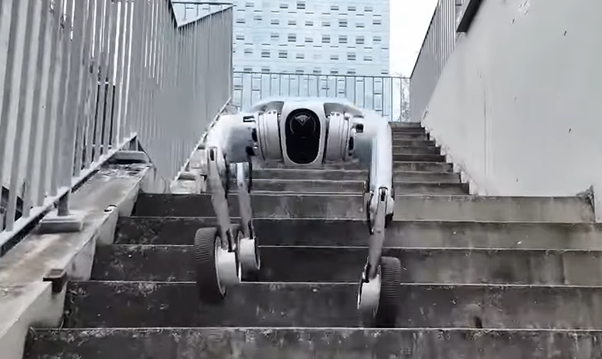
A newly released video of a hybrid quadruped robot suggests that this gap is beginning to close. The footage shows a wheeled-leg robot moving toward a staircase, lifting its legs, and climbing multiple flights at a steady pace before smoothly returning to wheeled motion on flat sections. According to Interesting Engineering, the clip is unedited and runs in real time, with the robot climbing stairs at roughly 1.5 meters per second—far faster than most legged systems typically manage.
The key lies in the robot’s hybrid design. Instead of choosing between wheels or legs, the platform uses both. Wheels handle most movement on smooth surfaces, conserving energy and maintaining high speed. When stairs or sharp elevation changes appear, the robot transitions to legged motion only for as long as needed. This approach treats legs as a specialized tool rather than the default mode of travel, allowing the system to remain efficient without sacrificing access.
Supporting this mobility is a substantial onboard computing stack. Dual processors, including NVIDIA’s Orin platform, provide enough processing power to run real-time mapping, obstacle avoidance, and path planning without constant human input. A 360-degree perception setup combining multiple cameras and high-resolution LiDAR sensors feeds dense 3D data into those algorithms, enabling the robot to navigate complex indoor and outdoor layouts.
The robot is designed for large, mixed environments. Claimed specifications include long-range autonomous travel, the ability to map very large facilities, and payload capacity suited to industrial tasks. On flat ground, it can reach speeds closer to wheeled vehicles, while still climbing steps up to 25 centimeters and handling moderate slopes.
From a defense and security perspective, this type of mobility has clear relevance. Military bases, logistics depots, ports, and urban environments often combine open areas with staircases and uneven terrain. A fast, autonomous platform that can move efficiently through such spaces could support perimeter patrols, logistics runs, or sensor deployment without relying on human operators. Speed matters not just for efficiency, but for responsiveness.
While demonstrations do not always translate directly into field performance, the video highlights a broader trend in robotics: shifting from carefully staged movements to fluid, adaptive mobility designed for the transitions that define real environments.
https://www.youtube.com/watch?v=yYS2pZtL07g