

This post is also available in:
 עברית (Hebrew)
Modern main battle tanks were designed to defeat threats coming from the front and sides. Today, that assumption no longer holds. Inexpensive first-person-view drones and loitering munitions have made the top of armored vehicles a primary target, exploiting areas that were never meant to absorb direct attack. Across recent conflicts, this shift has translated into heavy losses for even well-protected armor.
New imagery from late December suggests the South Korean military is actively responding to this challenge. Photos from an armored training exercise show K2 Black Panther main battle tanks operating with improvised anti-drone cage structures mounted above their turrets. The tanks appear to be participating in live-fire drills, indicating the modification is being tested under realistic conditions rather than as a static experiment.
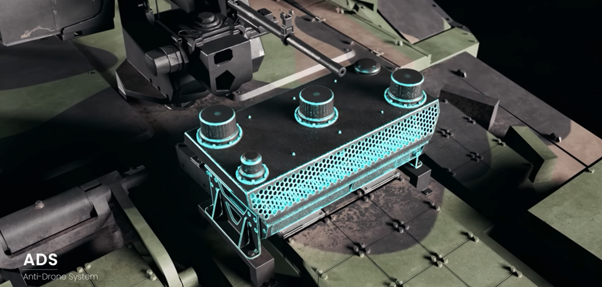
According to Interesting Engineering, the added structure resembles what has become widely known as a “cope cage”: a rectangular lattice built from welded metal frames and mesh panels. Mounted above the turret roof, the cage creates a stand-off distance between incoming threats and the tank’s primary armor. This spacing is intended to disrupt or prematurely detonate drone-dropped explosives and top-attack munitions before they reach critical areas.
Importantly, the design appears to minimize interference with the tank’s core functions. Open sections allow the 120mm smoothbore gun to elevate and traverse normally, while sensors, optics, and roof-mounted equipment remain accessible. The cage does not alter the hull, suspension, or ground clearance, suggesting it can be added without compromising mobility or requiring structural changes to the vehicle.
For defense planners, this type of adaptation reflects a broader reassessment of armored survivability. It is a modern fourth-generation tank with advanced fire-control systems, active protection, and a three-man crew, yet even such platforms face new vulnerabilities from low-cost aerial threats. Adding a relatively simple, removable cage offers a fast way to improve protection while longer-term counter-drone solutions mature.
Multiple tanks fitted with the cages were observed on the firing line, including one captured mid-shot with a visible muzzle flash, reinforcing the impression of a coordinated unit-level trial. Crews are likely evaluating how the added structure affects visibility, situational awareness, and day-to-day operation during combat drills.
South Korea’s experiment mirrors a global trend that has accelerated since the war in Ukraine, where armies have adopted improvised lattice armor to counter drones. While such cages are not a complete solution, they represent a pragmatic response to a rapidly changing threat landscape—trading minor inconvenience for increased survivability against attacks that now come from above.























