This post is also available in:
 עברית (Hebrew)
Modern battlefields are shaped as much by the electromagnetic spectrum as by physical terrain. Communications, sensors, navigation signals, and targeting systems all depend on clean, uncontested airwaves. The problem for militaries today is that adversaries can rapidly shift frequencies, conceal transmissions, or overwhelm receivers with noise. By the time operators identify what is happening, the window to respond may already be closing.
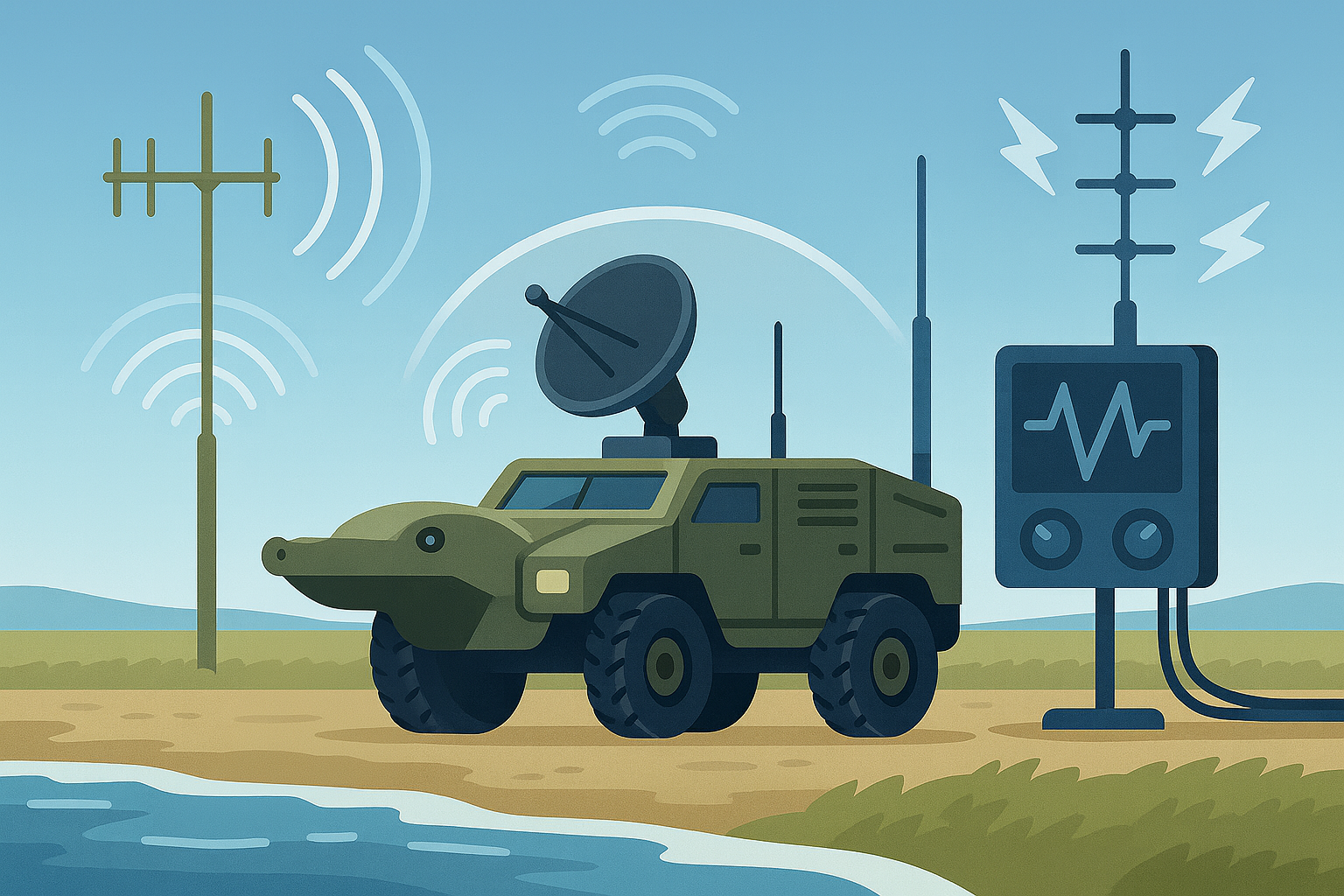
A new land-focused electronic warfare system called TAERVUS is designed to address that challenge by detecting, analyzing, and disrupting enemy signals faster than traditional EW architectures allow. Instead of treating sensing and jamming as separate functions, the platform merges them into a single operational framework built to capture spectrum awareness early and act on it immediately.
According to NextGenDefense, the system combines radio direction finders, high-performance receivers, and jamming or excitation tools into one modular system spanning high, very high, ultra-high, and microwave frequencies. This allows operators to monitor diverse signal types—from battlefield communications to radar emissions—and respond with targeted disruption. Because the architecture is software-defined, the system can be reconfigured for new missions or updated as threats evolve.
Artificial intelligence plays a central role. The system uses AI-led processing to classify signals, prioritize threats, and filter out irrelevant noise. The goal is to ease operator workload in environments where hundreds of simultaneous emissions can overwhelm manual analysis. The system also includes predictive jamming, which examines behavior patterns in the spectrum and recommends disruption strategies before enemy systems can adapt.
A tool like this offers a way to counter increasingly agile electronic threats. Ground forces rely on uninterrupted communications for coordination and targeting, while adversaries attempt to degrade those links or intercept sensitive information. A unified platform that both monitors and contests hostile emissions can help protect friendly networks while reducing an opponent’s ability to gather intelligence.
Beyond jamming, the system supports communications intelligence tasks, offering real-time awareness of who is transmitting, from where, and on what frequencies. This tight coupling between reconnaissance and action is intended to reduce reaction times and give commanders more options in fast-changing EW engagements.
By turning data processing, spectrum monitoring, and disruption into a synchronized workflow, the system seeks to give operators an information advantage—one that begins before the enemy’s signals even fully emerge.