This post is also available in:
 עברית (Hebrew)
Emergency responders and humanitarian agencies often struggle with the same issue: how to deploy sturdy, lightweight shelters quickly in disaster zones where transport is limited and assembly must be fast. Traditional materials either weigh too much or collapse under pressure, and rapidly deployable structures often sacrifice strength for portability. A new study led by a young researcher suggests that nature-inspired folding might offer an alternative.
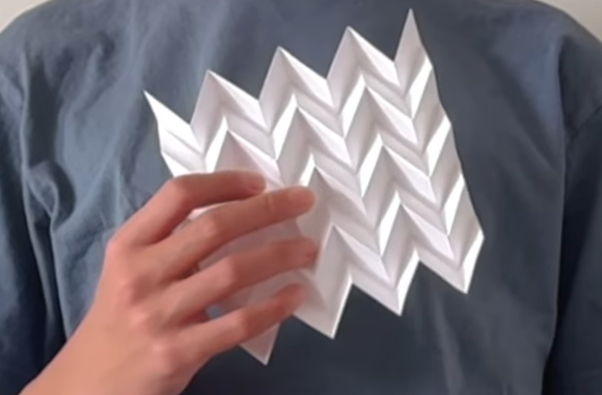
According to Interesting Engineering, the researcher set out to answer a practical question: whether the Miura-ori folding pattern, known for its strength and compactness, could be adapted for rapidly deployable shelters. To test this, he built 54 versions of the fold, adjusting panel size, fold angle, and paper type, and measured how much weight each could support before collapsing.
The results were far beyond expectation. One design supported more than 10,000 times its own weight, a figure the researcher calculated as equivalent to “a taxi carrying over 4,000 elephants”. Smaller panels and steeper folding angles produced structures that were both stronger and more resilient, while surprisingly, standard copy paper outperformed heavier cardstock in strength-to-weight ratio.
For defense and homeland-security applications, foldable high-strength structures could enable rapidly deployable shelters, blast-resistant barriers, lightweight protective panels, and compact infrastructure for field logistics. Folded structures can be transported flat, deployed on demand, and configured into rigid shapes without specialized tools, which is considered a significant advantage in crisis environments.
This work highlights how geometric design can dramatically influence structural performance, even with simple materials. His findings offer a starting point for engineers exploring ultralight, high-strength structures that could support disaster response, field operations, or temporary shelters in remote zones.
As research into deployable structures continues, origami-inspired designs may become practical tools for scenarios where portability, strength, and speed of deployment are essential.