

This post is also available in:
 עברית (Hebrew)
Construction projects generate enormous amounts of changing information each day—new installations, shifting materials, evolving layouts, and emerging safety hazards. Traditionally, engineers walk every floor with a 360° camera to document progress, a process that can take days on large sites and often produces data that is already outdated by the time it is reviewed. With labor shortages and safety pressures growing, many firms are searching for ways to automate the most time-consuming tasks without slowing down operations.
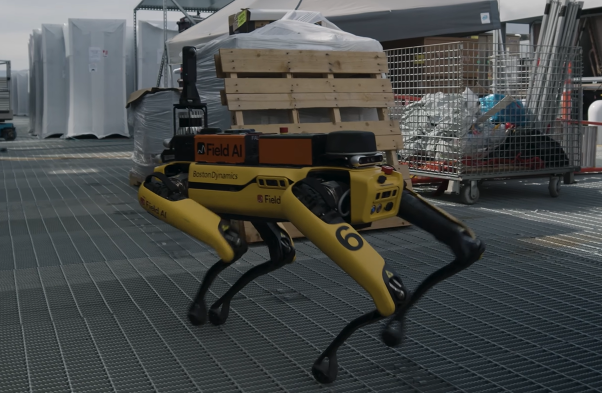
A new deployment in California demonstrates how quadruped robots equipped with advanced autonomy software can help fill that gap. Using FieldAI’s Field Foundation Models™, a Boston Dynamics Spot robot navigated a multi-floor project site without GPS or pre-mapped routes, adapting to daily changes in layout and obstacles. Over the course of the deployment, the robot walked more than 160 kms, captured 45,000 photographs, and scanned 46,450 square meters of interior space, creating a consistent digital record of construction progress.
The system tackles several problems at once. It automates extensive documentation work, reduces the need for personnel to traverse hazardous or cluttered areas, and maintains a near-continuous visual record of the site. Engineers no longer need to spend hours walking floors with cameras; instead, the robot produces structured datasets that can be reviewed remotely. This efficiency is significant for an industry facing an estimated 500,000-worker shortfall in the U.S. alone.
According to Interesting Engineering, beyond documentation, the robot dog also monitored material movement, conducted safety and hazard checks, and supported site security. The data collected was processed into a “living” digital model of the jobsite, allowing managers to detect risks, verify installation work, and plan tasks more accurately.
For homeland-security and defense infrastructure projects, where safety requirements and documentation needs are even more stringent, such autonomous systems could play a similar role. Large bases, logistical hubs, and critical facilities often require continuous inspection and mapping—work that can be dangerous or resource-intensive for human teams. A robot capable of self-navigation and persistent monitoring offers a reliable, low-risk alternative.
As adoption expands, autonomous mapping and hazard detection may become standard across large industrial and public-sector projects. The deployment suggests that robot dogs are moving from novelty to practical tools—automating routine work so human teams can focus on building, planning, and problem-solving.























