

This post is also available in:
 עברית (Hebrew)
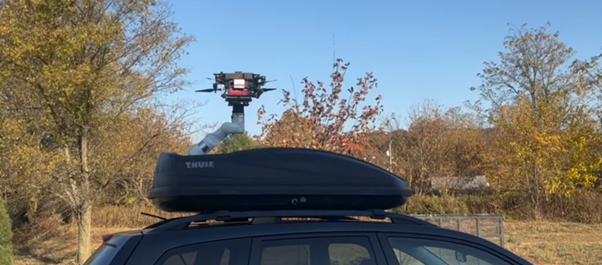
Launching and retrieving drones normally requires a stationary platform, clear airspace, and operators with line-of-sight control. These constraints limit how quickly drones can be used in emergencies or in high-tempo military operations, where vehicles rarely stop and time on target is limited. A newly introduced robotic system, known as Ralar, aims to remove those constraints by enabling fully automated drone launch and recovery while a vehicle is in motion.
The core problem the arm addresses is operational delay. Traditional workflows force first responders, security teams, or military units to halt their vehicles before deploying a drone, losing momentum and exposing personnel to additional risk. The system solves this with a roof-mounted robotic arm and carriage system that stabilizes drones during launch and guides them back into the container for recovery, even when the host vehicle is moving over uneven terrain.
Designed as a ruggedized, self-contained module, the system integrates its own power supply and control electronics, allowing installation on SUVs, trucks, naval craft, or unmanned vehicles without requiring major modifications. Once mounted, drones can be automatically launched based on mission cues, sensor triggers, or operator commands. During recovery, it uses onboard guidance and mechanical synchronization to match the drone’s motion with the movement of the host platform.
For defense and homeland security missions, this capability enables continuous aerial surveillance and rapid reconnaissance from convoys, patrol boats, or autonomous ground platforms. A drone could lift off the moment a sensor detects unusual activity, or provide overwatch during logistics movements, without slowing down the unit’s tempo. The system creates a more connected operating picture by ensuring drones can deploy and return without interrupting the mission.
It is also positioned for civilian uses such as emergency response, mobile inspections, and delivery services. A fire command vehicle, for example, could deploy a drone while en route to a scene, gaining situational awareness before arriving. Utilities or telecom operators could survey infrastructure without stopping service vehicles, reducing inspection times.
The system is compatible with AI-driven software tools that manage flight paths, stabilization, and target tracking, allowing drones to operate with minimal operator input. By turning almost any vehicle into a mobile drone hub, it demonstrates how robotic launch-and-recovery systems may become a key enabler for real-time intelligence and rapid decision-making across both security and civilian sectors.























