This post is also available in:
 עברית (Hebrew)
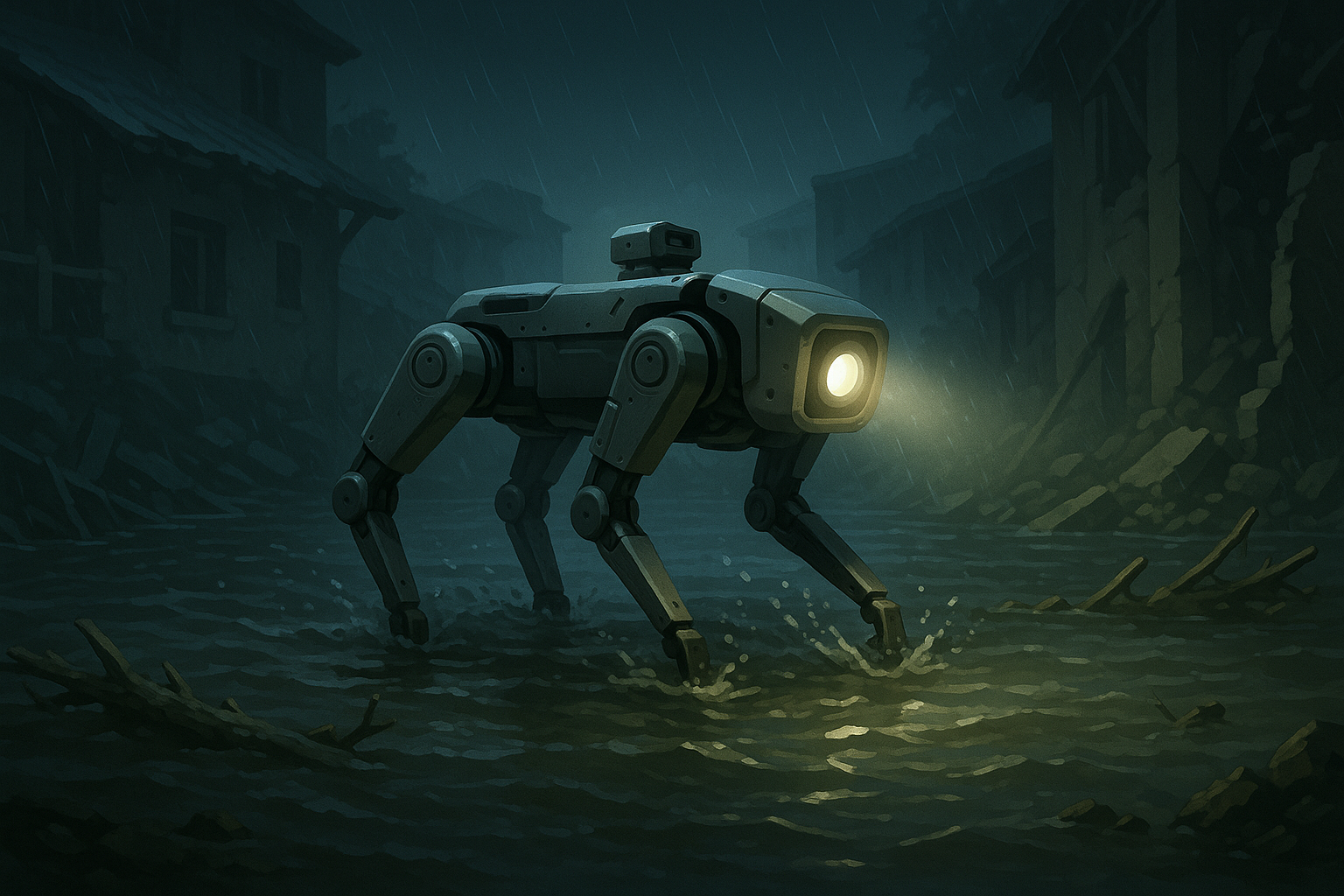
Major disasters often create environments too unstable or hazardous for human rescuers to enter. Collapsed structures, toxic fumes, flooding, and narrow access points can delay lifesaving operations and expose responders to significant danger. A recent emergency-response drill demonstrated how advanced quadruped robots may help bridge this gap by navigating terrain that is unsafe or unreachable for people.
During a large-scale simulation in Hangzhou, the X30 quadruped robot was tested across multiple accident scenarios to determine whether it could locate several trapped individuals under realistic disaster conditions. The drill replicated the challenges faced by firefighters and emergency teams during structural collapses and industrial accidents, where debris, unstable surfaces, and environmental hazards limit movement and visibility.
The system’s core strength lies in its four-legged bionic structure and adaptive gait control, allowing it to climb steep stairs, pass through tight scaffolding, and traverse rubble-strewn paths without losing balance. Its IP67 protection rating enables operation in heavy dust, pooled water, and other conditions that would normally halt or endanger human responders.
According to Interesting Engineering, to provide decision-makers with timely situational awareness, the robot uses full-scene scanning and long-range video to generate 3D models of the disaster site. These data streams are transmitted through a self-organizing broadband network to command screens, where operators can assess obstacles, monitor environmental changes, and coordinate their response. The system also integrates with facial-recognition-enabled search tools, allowing the robots to help pinpoint the locations of simulated victims.
The system’s role extends beyond immediate rescue. Each mission includes digital documentation of the environment for later analysis, enabling teams to plan follow-up operations with greater accuracy. This capability mirrors the needs of homeland-security organizations and defense forces, which increasingly rely on unmanned systems to assess hazardous sites, conduct reconnaissance, and reduce human exposure during high-risk missions.
The robot’s specifications—such as a four-hour battery, 56-kg frame, and ability to operate from –20°C to 55°C—support deployment in diverse climate conditions. Previous drills have shown it working alongside drones during typhoon, flood, and chemical-response simulations, reinforcing its value as part of a multi-robot team.
The Hangzhou exercise highlights a larger trend: intelligent ground robots are moving from trial demonstrations to practical support tools. As autonomous mobility improves, machines like this one are likely to become standard assets in both civil-rescue and security operations, complementing human teams where conditions are too dangerous for direct entry.