This post is also available in:
 עברית (Hebrew)
Aircraft wings have followed broadly familiar shapes for more than a century, but unconventional designs can behave very differently in the air. One challenge is maintaining stability when wind pushes an aircraft off course, particularly for small or lightweight platforms. An experiment with circular wings suggests that closing the wing into a ring can produce some interesting flight characteristics.
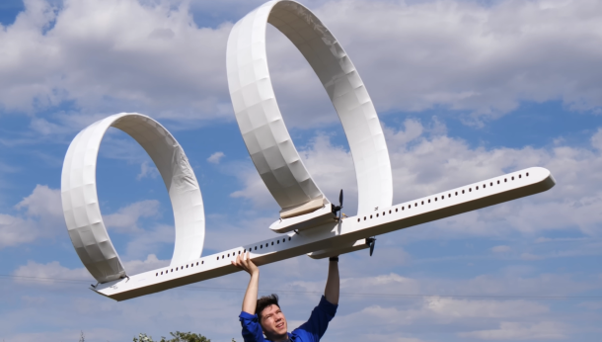
British YouTuber James Whomsley, known for his ProjectAir channel, developed a radio-controlled aircraft with ring-shaped wings, taking the concept from tiny prototypes to a large, powered model. The project was inspired by a circular paper aircraft he remembered flying as a child.
The underlying aerodynamic principle is not entirely different from a conventional wing. As the circular structure travels through the air at an angle of attack, differences in air pressure around its surfaces generate lift. The key difference is that the wing forms a closed loop rather than extending outward as two separate surfaces.
The youtuber initially tested the concept using 12-gram balsa models powered by rubber bands. After experimenting with several configurations, the most successful used a large ring near the front for lift and a smaller rear ring for stability.
He then compared it with a conventional straight-wing model offering approximately the same wing area. Both received 150 turns of their rubber-band motors. In breezy conditions, the conventional aircraft remained airborne for around seven seconds, while the circular-wing model exceeded 10 seconds, travelled farther and repeatedly corrected itself after being disturbed by the wind.
Scaling the concept proved considerably harder.
According to Interesting Engineering, a larger aircraft was designed digitally, with laser-cut balsa components assembled into two ring wings and a reinforced fuselage. The unfinished wing structures alone weighed approximately 2.13 kilograms. Glide testing confirmed that they could generate lift, but the aircraft required additional nose weight and a relatively high angle of attack.
Two powered versions subsequently crashed, with the rigid balsa spars breaking during unsuccessful launches. For the third design, the wings were rebuilt using foam and aluminum tubing, providing greater flexibility. Initial testing revealed that the ring distorted under aerodynamic loads, so a central brace was added to prevent it from expanding.
With the motors mounted rigidly to the fuselage, the redesigned aircraft finally completed a controlled flight lasting several minutes. According to the youtuber, it handled similarly to a conventional RC aircraft while showing particularly strong stability around its roll axis.
Although the experiment was not developed for defense, unusual wing configurations could be relevant to future unmanned aircraft research. Greater passive stability in wind could potentially benefit small surveillance drones or platforms operating in turbulent environments, although considerably more aerodynamic testing would be needed before drawing conclusions about practical advantages.
The demonstration does not prove that circular wings outperform conventional aircraft designs. It does show, however, that a properly reinforced ring wing can generate sufficient lift for sustained, controllable powered flight, and that a childhood paper-plane idea can survive the transition to a much larger aircraft.