

This post is also available in:
 עברית (Hebrew)
Minefields remain one of the most dangerous obstacles on the battlefield. Before armored vehicles or troops can advance, engineers must first clear explosive hazards and then mark the safe route for following forces. Traditionally, these are separate tasks that can slow operations and, in some cases, require personnel to leave the protection of their vehicles to place lane markers by hand.
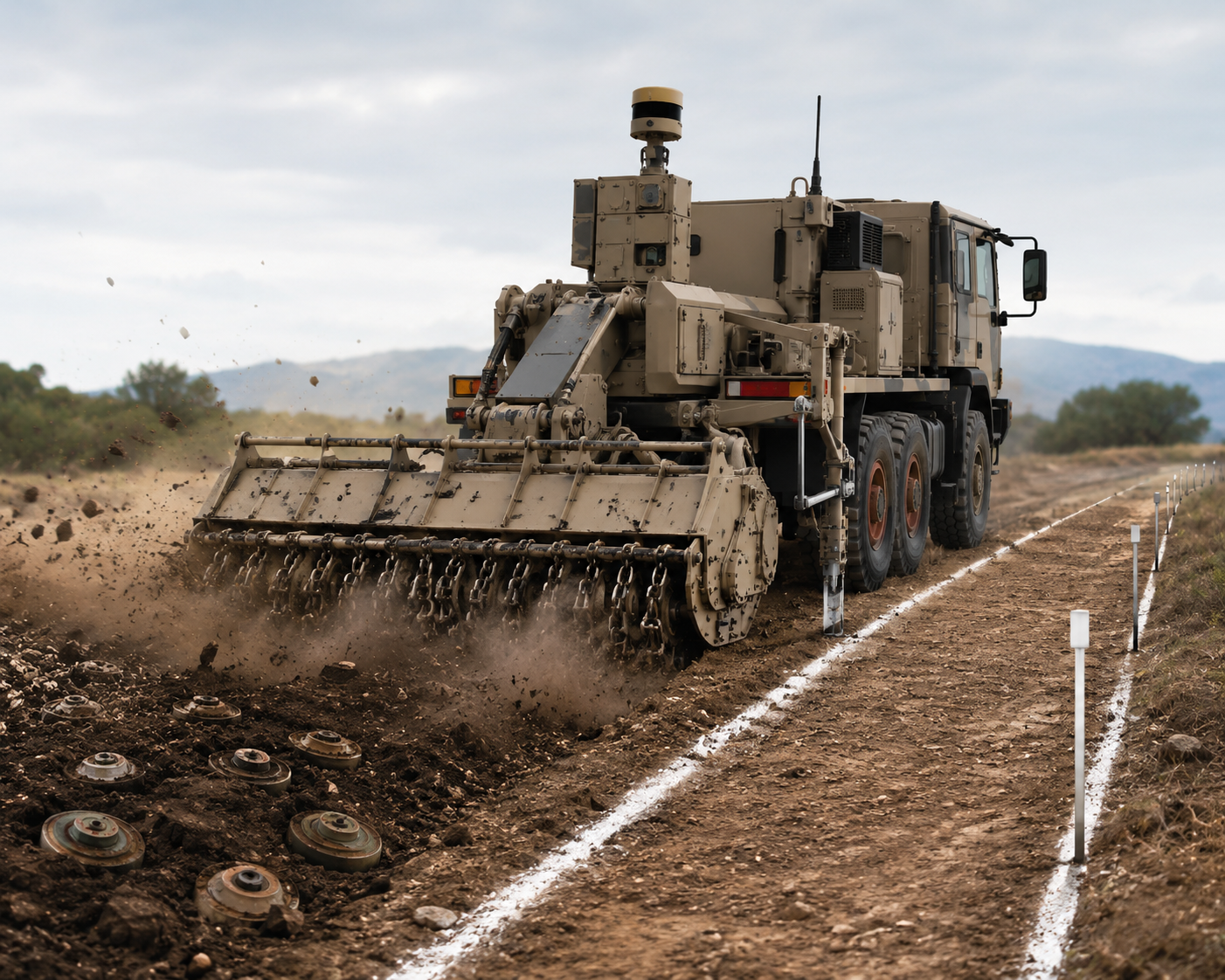
A newly introduced system (by Global Clearance Solutions) aims to eliminate that extra step by combining minefield breaching and lane marking into a single continuous process.
Mounted on the front of wheeled or tracked armored vehicles, the platform integrates a Modular Mine Plow with an automated lane-marking system. As the vehicle clears a path through a suspected minefield, it simultaneously deploys visible markers along the safe corridor without stopping or requiring additional personnel outside the vehicle.
The Mine Plow is designed to push aside landmines and other explosive hazards rather than detonating them in place. Operators can adjust the clearing depth between 5 and 300 millimeters while the vehicle is moving, allowing the system to adapt to changing soil conditions or different types of buried threats without interrupting the mission.
Behind the plow, the integrated marking system continuously places pole-mounted markers on one or both sides of the cleared lane. According to NextGenDefense, the markers use glow-in-the-dark materials and can be equipped with optional tactical lighting, helping following vehicles identify the safe route during nighttime or low-visibility operations.
Combining both capabilities into one platform reduces the time needed to establish a usable breach while minimizing crew exposure. Instead of stopping after clearing a lane and sending personnel outside to mark it manually, the entire process is completed as the vehicle advances.
From a defense perspective, rapid minefield breaching is essential for maintaining battlefield mobility. Delays at minefields can slow offensive operations, create traffic bottlenecks, and expose vehicles to enemy fire. Automated lane marking helps ensure that following units remain within the cleared corridor, reducing the risk of accidental entry into uncleared areas.
The modular design also allows the system to be installed on different armored vehicle types, increasing deployment flexibility across engineering and combat formations.
As landmines continue to pose a significant threat in modern conflicts, technologies that shorten breaching operations while keeping crews protected inside armored vehicles are becoming an increasingly important component of military mobility and force protection.























