

This post is also available in:
 עברית (Hebrew)
The wireless networks envisioned for the 6G era promise enormous data rates, potentially reaching terabits per second. Achieving those speeds, however, requires the use of much higher-frequency radio waves than today’s networks. While these frequencies can carry vast amounts of information, they have a significant drawback: they are easily blocked by walls, furniture, machinery, and even groups of people.
This creates a difficult challenge for indoor connectivity. Conventional solutions often involve installing additional repeaters, routers, or base stations to push signals into hard-to-reach areas. Those systems add cost, consume power, and require ongoing maintenance.
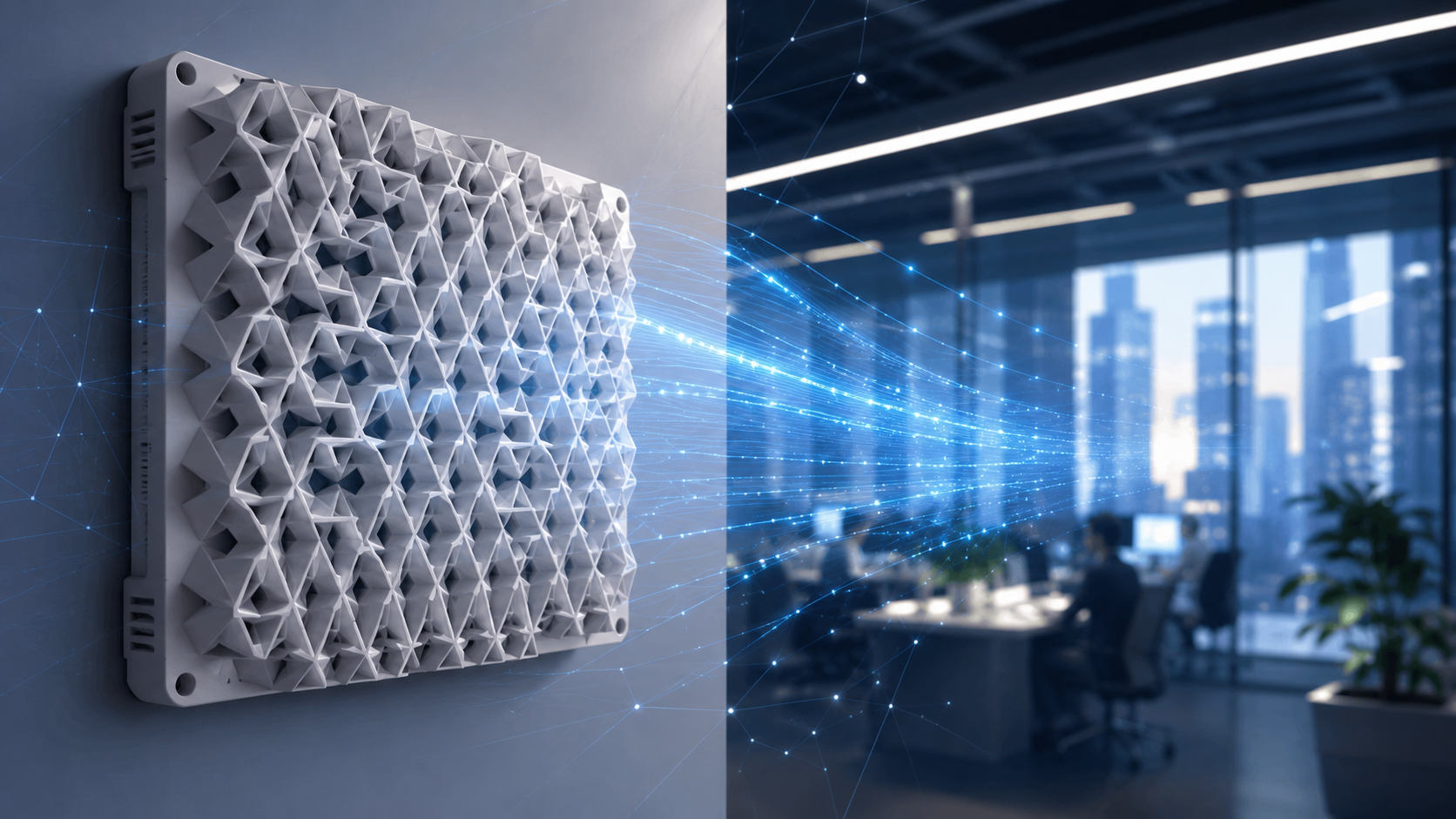
Researchers have now developed a different approach based on passive structures known as metacrystal panels. Rather than generating or amplifying signals, these panels physically redirect radio waves, guiding them around obstacles and toward areas where coverage is weak.
The technology is built using 3D-printed volumetric structures made from low-cost plastic materials. At first glance, the panels resemble ordinary geometric objects, but their internal architecture has been carefully designed using computational optimization. The shapes inside the panel manipulate electromagnetic waves as they pass through or reflect from the structure.
The concept is similar to using mirrors to redirect light into a dark room. Instead of light, however, the panels control high-frequency radio signals. Mounted on walls, ceilings, or even furniture, they can redirect wireless energy around corners, into dead zones, or toward specific devices.
According to Interesting Engineering, one of the key differences from earlier metasurface technologies is the move from flat two-dimensional designs to three-dimensional structures. Traditional metasurfaces often struggle when signals arrive from multiple directions or different angles. The new volumetric architecture provides additional degrees of freedom, allowing multiple signals and frequency bands to be manipulated simultaneously.
From a defense and security perspective, passive signal-routing technologies could prove valuable in command centers, industrial facilities, underground structures, and other environments where maintaining reliable communications is critical. Because the panels require no electricity, they could continue functioning without additional power infrastructure.
Another advantage is cost. The panels can be fabricated using inexpensive materials and customized for specific environments. Researchers are already exploring future versions capable of adapting dynamically to changing conditions, potentially creating reconfigurable wireless environments without the complexity of traditional network hardware.
As wireless systems move toward higher frequencies, technologies that help signals navigate real-world obstacles may become just as important as the radios themselves.























