

This post is also available in:
 עברית (Hebrew)
Armored vehicles are facing a wider and more complex threat environment than ever before. Alongside traditional anti-tank missiles and rocket-propelled grenades, modern battlefields are now saturated with small drones, loitering munitions, and high-speed kinetic rounds. Passive armor alone is no longer sufficient to protect crews against weapons that can strike from multiple directions and at very short notice.
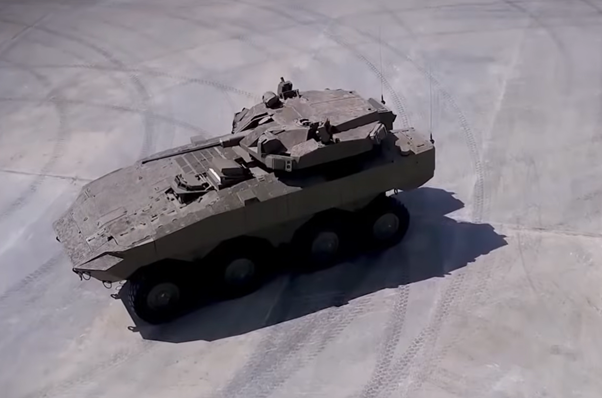
Active protection systems are designed to close that gap by detecting and neutralizing threats before impact. One such system, Iron Fist (by Israel’s Elbit Systems), has recently demonstrated an expanded defensive envelope in live testing. New footage shows the system successfully intercepting quadcopter-style drones and small fixed-wing unmanned aircraft in flight, in addition to more familiar anti-armor threats. The tests also include the defeat of rocket-propelled grenades, anti-tank guided missiles, and kinetic-energy penetrators—solid metal projectiles traveling at extreme speed.
According to Interesting Engineering, it combines radar and infrared sensors to provide continuous, 360-degree monitoring around the protected vehicle. Once a threat is detected and tracked, the system launches a compact interceptor that neutralizes the incoming weapon at a safe distance. Unlike systems that rely on detonating the threat’s warhead, it uses a blast-based interceptor to disable the projectile itself, reducing collateral effects near the vehicle.
The system is offered in multiple configurations, allowing it to be tailored to different platforms. Lighter versions are intended for infantry fighting vehicles and logistics platforms, while heavier configurations are designed for main battle tanks. A key design consideration has been minimizing size, weight, and power requirements, enabling integration without significantly affecting vehicle mobility or payload.
The addition of counter-drone capability reflects how vehicle protection requirements are evolving. Small, low-cost aerial threats are increasingly used for reconnaissance and attack, often in dense or urban environments where reaction times are minimal. An active protection system that can engage both ground-launched and aerial threats provides a single, integrated layer of defense.
Systems like this play a critical role in improving battlefield survivability. By intercepting threats before they strike, they reduce vulnerability to ambushes and precision attacks, allowing armored units to operate with greater confidence in contested areas. As armored forces adapt to mixed threats from missiles, drones, and kinetic weapons, active protection is becoming a core component of modern vehicle design rather than an optional add-on.























