This post is also available in:
 עברית (Hebrew)
Firefighting and disaster response increasingly place human crews in environments that are unstable, toxic, or simply unreachable. Collapsed structures, chemical leaks, tunnel fires, and industrial blazes often limit visibility, disrupt communications, and expose responders to extreme heat and hazardous gases. These conditions make early reconnaissance and sustained intervention particularly dangerous, while delays in understanding the scene can cost lives.
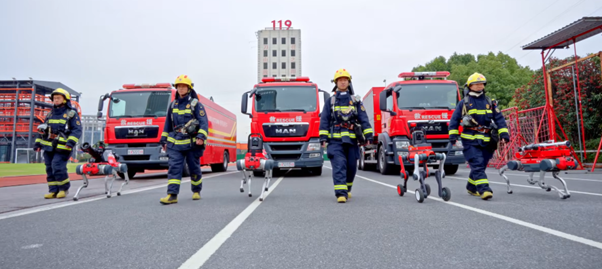
A new approach aims to shift much of that initial risk away from human responders. An AI-enabled firefighting system built around coordinated ground robots is designed to handle reconnaissance, suppression, and logistics as a single integrated operation. Rather than deploying one machine for a single task, the system functions as a closed loop: sensing the environment, acting on threats, and continuously updating operators with real-time data.
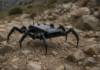
According to Interesting Engineering, at the front end are reconnaissance robots, including quadruped and wheeled-legged platforms built to traverse debris, stairs, and narrow passages. Equipped with LiDAR, dual-spectrum pan-tilt-zoom cameras, and gas detection sensors, they can map hazardous areas, identify heat sources, and detect toxic leaks in low-visibility conditions. Audio modules allow two-way communication with trapped individuals, enabling basic interaction before human teams enter the scene.
Fire suppression is handled by dedicated robotic units designed for different scenarios. Quadruped robots fitted with water guns use high-pressure pulse systems to generate fine water mist, helping suppress flames while keeping operators at a safe distance. Larger water cannon robots can project water or foam up to 60 meters, with adjustable spray patterns to navigate obstacles and confined spaces. Both platforms incorporate thermal protection and active cooling, allowing them to operate close to intense heat for extended periods.
Supporting these units are autonomous logistics robots that transport equipment such as air tanks, tools, and supplies, reducing the physical burden on crews and maintaining operational tempo during prolonged incidents. All elements are linked through a low-latency communication network that remains functional in weak-signal environments. When combined with aerial drones, the system creates a layered air-ground-underground view of the incident, including real-time mapping and 3D visualization.
From a homeland security and defense perspective, such systems have clear relevance beyond civilian firefighting. They could be used to respond to industrial sabotage, chemical or gas attacks, and large-scale infrastructure incidents, where rapid situational awareness and minimal human exposure are critical. As emergency response increasingly overlaps with security scenarios, autonomous robotic teams offer a way to extend reach while reducing risk to personnel.