

This post is also available in:
 עברית (Hebrew)
A new technology developed by researchers at EPFL (Swiss Federal Technology Institute of Lausanne) may offer a non-surgical alternative for treating internal injuries. The system, called MEDS (Magnetic Endoluminal Deposition System), is a swallowable capsule capable of printing living biomaterial directly onto damaged tissue inside the gastrointestinal (GI) tract — without the need for incisions, anaesthesia, or bulky external devices.
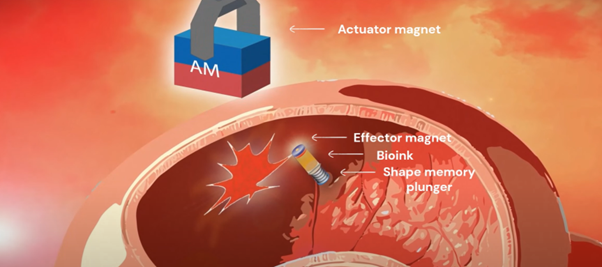
At its core, the MEDS device combines magnetically controlled navigation with bioprinting capabilities. Roughly the size of a large pill, the capsule contains a chamber of bio-ink, a gel-like substance made of biocompatible polymers that supports cellular growth. The capsule is activated externally using a near-infrared laser, which triggers a spring-based mechanism to release the bio-ink at a precise location inside the body. This ink acts as both a protective layer and a scaffold for tissue regeneration.
Once inside the body, an external magnetic arm guides the capsule toward the targeted injury — much like controlling a joystick. Using this approach, the system can deposit living material directly onto ulcers, bleeding sites, or other damaged soft tissue, avoiding the trauma and risks associated with surgery.
According to Interesting Engineering, initial lab trials with artificial stomach models demonstrated that the device could successfully cover simulated wounds of various shapes and seal bleeding points. More recently, the system was tested in vivo in rabbits, where it showed effective navigation and ink delivery in the stomach, tracked in real time using x-ray fluoroscopy.
Beyond wound coverage, the bio-ink has potential as a treatment platform. In laboratory settings, the printed material maintained its shape and biological properties for over two weeks, suggesting it could serve as a delivery site for growth factors and a base for new cell recruitment.
If further validated, this technology could lead to a new class of minimally invasive medical tools — especially valuable for treating internal injuries where surgery is either too risky or impractical.
The study was published in the Advanced Science journal.























