

This post is also available in:
 עברית (Hebrew)
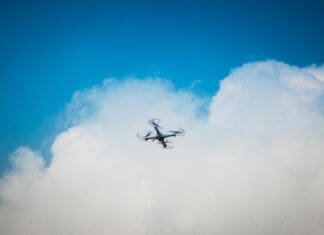
Intercepting hostile drones requires aircraft that can launch quickly, maneuver efficiently and reach moving targets without placing excessive demands on their operators. Conventional multirotor drones can take off from confined spaces, but maintaining a hover-based flight configuration is not always ideal for pursuing aerial threats. Switching between different flight modes introduces another challenge, particularly when pilots must manage the transition manually.
A new counter-drone interceptor called Guardian-3 is designed to simplify that process by automatically transitioning from vertical takeoff to forward flight.
Developed by Powerus Corporation, the aircraft was unveiled at the Association of the United States Army’s 2026 Annual Meeting and Exposition.
The interceptor initially lifts off and hovers like a quadcopter. Once airborne, it automatically pitches forward into a nose-first cruising configuration, without requiring the operator to control the maneuver.
According to Interesting Engineering, this allows the interceptor to combine the launch flexibility of a multirotor aircraft with a separate forward-flight mode intended for pursuing aerial threats.
The operator remains responsible for authorizing launch, but the aircraft handles the subsequent transition independently.
One of the interceptor’s more unusual features concerns its GPS receiver, which is mounted on the camera gimbal rather than remaining fixed to the aircraft’s body.
As the interceptor pitches forward, the gimbal helps keep the GPS antenna oriented toward the sky. This is intended to maintain a suitable antenna position even as the aircraft changes its flight attitude.
The design addresses a practical challenge for drones that operate in multiple orientations, although the company has not disclosed navigation accuracy figures or demonstrated performance under GPS jamming.
Another engineering feature is the aircraft’s ducted cooling system for its electronic speed controllers (ESCs), which regulate electrical power delivered to the motors.
Hovering and sustained high-speed operation create different cooling demands. The ducted arrangement is intended to maintain airflow around these components during both hovering and full-throttle flight.
The interceptor represents the third generation of the company’s interceptor family. Its predecessor, Guardian-2, introduced semi-autonomous capabilities, while the new version automates additional flight functions.
For military counter-UAS operations, reducing the number of tasks requiring direct pilot input could help operators manage engagements more efficiently, particularly when multiple aerial threats appear.
However, automatic flight transitions do not necessarily mean autonomous interception. The manufacturer has not explained how Guardian-3 detects, identifies, tracks or engages its targets.
Its speed, range, endurance, propulsion configuration and production schedule also remain undisclosed.
For now, it demonstrates an approach to simplifying interceptor flight: allowing an aircraft to launch vertically and transition into forward flight on its own, leaving operators with fewer manual flight tasks during the early stages of a mission.