This post is also available in:
 עברית (Hebrew)
Armored vehicles increasingly face threats from two directions at once. Infantry fighting vehicles still need enough firepower and protection to confront troops and armored targets on the ground, but the spread of small, unmanned aircraft means crews must also watch the sky. Adding separate counter-drone vehicles to every formation is one solution; giving existing combat vehicles another job is another.
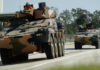
A new configuration of the Redback Infantry Fighting Vehicle (IFV) takes the second approach, combining its traditional battlefield role with counter-UAS capabilities.
The upgraded IFV integrates a new Lockheed Martin UK turret armed with CTA International’s 40mm cannon and equipped with the SkyKeeper command-and-control system. Together, the technologies are intended to let the tracked vehicle support both conventional engagements and defense against unmanned aircraft.
The 40mm weapon represents a step up from the 30mm Mk44S Bushmaster II cannon normally carried by the IFV. Hanwha Aerospace selected the larger weapon partly because of the range of ammunition available for it, providing flexibility for different target types and operational requirements.
According to NextGenDefense, the C2 system adds the command-and-control layer needed for the counter-drone mission, allowing the vehicle to participate in C-UAS operations rather than functioning only as a direct-fire platform.
The configuration also demonstrates the IFV’s ability to accept new mission equipment without developing an entirely new vehicle. Live demonstrations are planned for 2027 for countries examining next-generation infantry fighting vehicles.
Counter-drone capability is being added to a platform already designed around battlefield survivability.
The IFV combines heavy passive armor with an Active Protection System (APS). While conventional armor provides a physical barrier, the APS is intended to intercept incoming guided missiles and rocket-propelled grenades before they strike the vehicle.
Protection against threats from below is addressed through a reinforced hull designed to deflect and absorb explosive forces. Blast-mitigating seats are also intended to reduce injuries to personnel when mines or improvised explosive devices detonate underneath or nearby.
In its conventional configuration, the vehicle can also carry a coaxial machine gun and integrate anti-tank guided missiles, allowing it to engage infantry and armored vehicles. An R400 Remote Weapon System has additionally been selected for Australian IFV vehicles.
The new configuration reflects how the role of armored vehicles is expanding as drones become a routine battlefield threat. An IFV can no longer be designed solely around what approaches across the ground.
By combining a 40mm cannon, counter-drone command-and-control and existing protection systems on one tracked platform, the upgraded IFV is being positioned to deal with threats around the vehicle, not just directly in front of it.