

This post is also available in:
 עברית (Hebrew)
Explosive ordnance disposal teams, special operations units, and emergency responders often face a difficult dilemma: gaining information about a potentially dangerous area without exposing personnel to unnecessary risk. Whether investigating suspicious packages, clearing buildings, or operating in confined urban environments, obtaining situational awareness quickly can be critical.
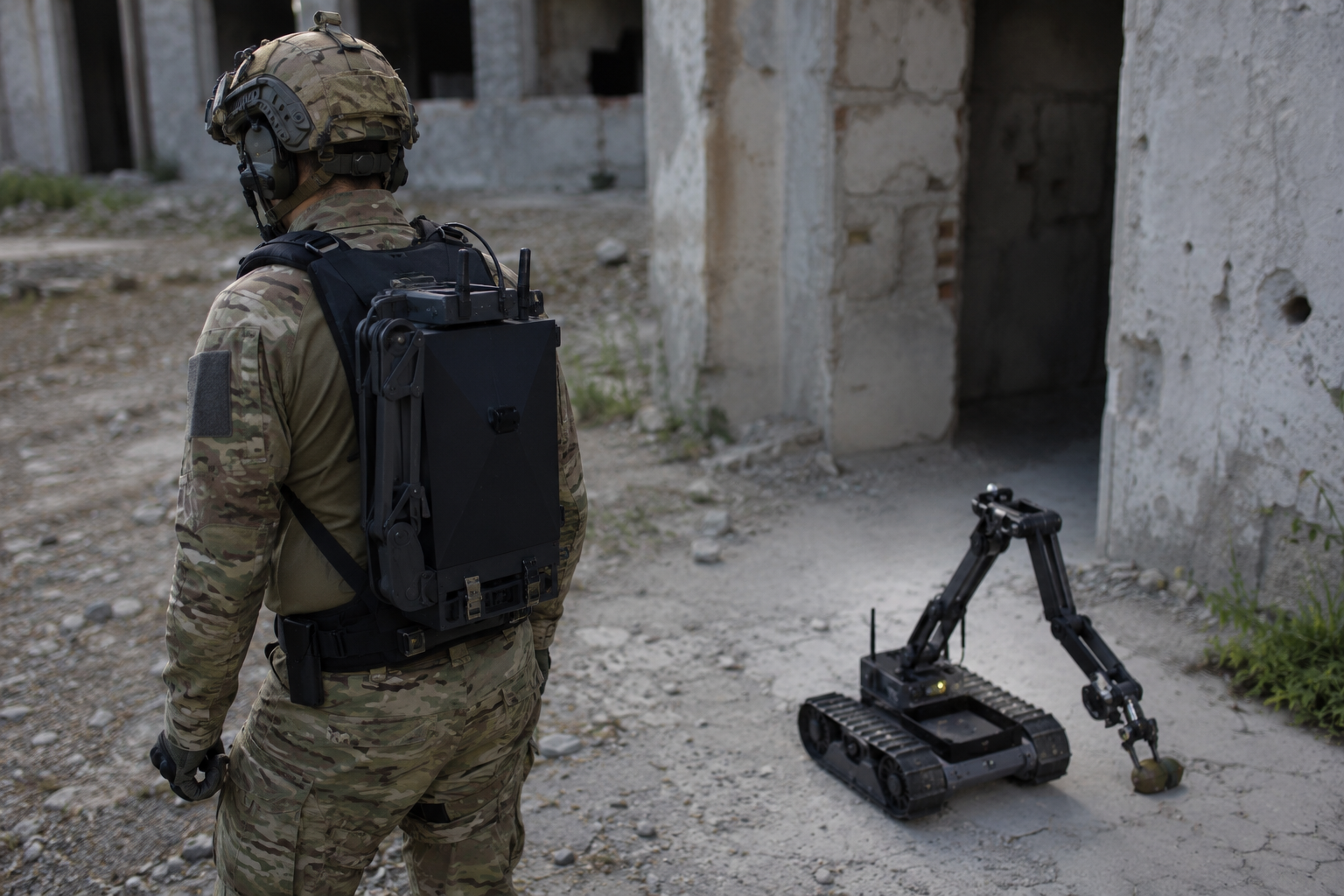
A new lightweight robotic platform (TOM 50 RE by AeroVironment) has been developed to address that challenge. Weighing less than 10 kilograms, the unmanned ground vehicle is designed to be carried in a backpack and deployed by a single operator, providing reconnaissance, mapping, and bomb disposal capabilities in areas where human access may be hazardous.
The compact robot uses a tracked mobility system equipped with stair-climbing flippers, allowing it to navigate steps, uneven surfaces, rubble, and confined indoor spaces. This mobility is particularly important for explosive ordnance disposal missions, where threats are often located inside buildings or difficult-to-reach locations.
One of the platform’s key capabilities is simultaneous localization and mapping (SLAM). Using onboard sensors, the robot can generate detailed digital maps while moving through unfamiliar environments. Unlike systems that depend on satellite navigation, SLAM allows the robot to operate in GPS-denied locations such as underground structures, tunnels, and dense urban areas.
The generated maps can be used immediately for mission planning. Operators can identify points of interest, mark hazards, and export information for further analysis.
According to Interesting Engineering, situational awareness is provided through four high-resolution wide-angle cameras that deliver full 360-degree coverage. Infrared capability allows observation in darkness and low-visibility conditions, helping operators maintain awareness regardless of lighting conditions.
The robot can also carry mission-specific payloads. With a payload capacity of up to five kilograms, it can be equipped with explosive disposal tools, advanced sensors, cameras, disruptors, or communications equipment. In addition, its networking architecture enables it to function as a communications relay, extending connectivity inside structures or other challenging environments.
From a defense and security perspective, compact robotic systems like this are increasingly valuable because they allow personnel to gather information, investigate threats, and perform hazardous tasks while remaining at a safer distance.
With up to five hours of endurance, autonomous mapping capabilities, modular payload support, and a highly portable design, the platform reflects the growing role of small robotic systems in military, law enforcement, and public safety operations.























